The world has changed since the Awakening.
Each night, billions of people take specially-designed sedatives to put themselves to sleep. They can rest peacefully, knowing that they are safe. But there are some who, either by choice or by circumstance, do not take any sedatives. Such people become Conduits--channels through which nightmarish creatures can leak through from the dream world into our own.
Having accidentally orphaned yourself during the Awakening, you have vowed to capture or destroy all the dream creatures that slip through.
The world has changed since the Awakening. It has given you a purpose.
Dream Hunter is a solitaire game of investigation and battle as you hunt down the creatures released from others' dreams. Follow the clues, then capture or destroy the dream before it turns the world into a nightmare.
Likely card-based, with a small to medium-sized board.
Popular Posts
-
 THE DEFECT The Defect has some of the strongest Power cards in the game, and has incredibly good passive damage. It has an intriguing starti...
Friday, October 25, 2013


Wednesday, September 18, 2013
Game Concept: The Fall
This has been a frustratingly busy semester for me. I'm taking several intensive courses that require a great deal of reading and thoughtful discussion of the texts. My wife's writing/editing job ebbs and flows throughout the year and is currently at an ebb, so I've had to put in more hours at my work to make up the difference. Plus, my wife is taking an insane number of advanced Greek and Latin classes, which keep her busy busy busy, leaving me to shoulder much of the daily house chores--dishes, cooking, laundry, trash, etc. I don't mind in the slightest, but all this means that I rarely have a confluence of both time and the energy for creative projects.
The TESS rules and module are unlikely to be ready before the 2013 Solitaire PnP Design Contest deadline. I'm okay with that. It's a big game that will need a lot of testing to make sure that the core mechanics work, and then even more testing to find a good balance. If it needs time to percolate, all the better for the game.
This has given me a lot of time to ponder about other concepts I have been keeping in my back pocket. One of them is The Fall. This began as a concept for a video game JRPG several years ago--the main character goes on a quest, and collects new friends and allies and new equipment and abilities along the way. I recently sketched out some ideas in my head that MIGHT allow this game to see daylight as a tabletop game.
THEME
The main character is climbing across a huge chasm when his line snaps and he plummets deep into the earth. Instead of splattering onto rock or nosediving into lava, however, he slips through a magic mortal that transports him into a giant underground world. He gets entangled in the political intrigue of two warring nations when it is discovered that he is entirely immune to all forms of magic. To get back home, he must join with one of these enchanted nations, lead a team into enemy territory, and gather the components needed for the queen to build him a machine to take him to the surface.
CHARACTERS
--A climbing and spelunking enthusiast from our modern world who, for whatever reason, is completely immune to magic.
--An enchantress/queen struggling to protect her nation from invasion.
--A cunning sorceress/queen with a thirst for destruction.
--A young girl with an incredible talent for sorcery.
--A warrior/scholar devoted to protecting the young girl.
--An exiled skreeling (sort of a goblin-like creature) looking for new friends and a new home.
--A mechanical man with a burning desire to be useful.
--An armored cave bear on a quest to avenge her slain cubs.
MECHANICS
This is where much of my thoughts have been these last few days. I recall playing Final Fantasy X years ago and admiring a great many things about the game's design. One neat thing that the game did was give each hero a unique special move with a powerful effect, with each move requiring the player to perform a different mini-game. With one character, you had to rotate the thumbstick as many times as possible within a short time limit. With another, you had to pause a slider within a small area as it moved back and forth. With yet another, you had to play a game of slots and try to get three of a kind for maximum effect.
This got me to thinking--what if each character in The Fall had a unique battle mechanic? Once the player has a full party, he or she can select the three characters (or the three mini-games) he or she enjoys the most and bring them into the combat situations. One character might use a Yahtzee-style dice mechanic. One might require the player to flip a coin a number of times. One may use the strike/maneuver poker card mechanic from my own Wings of Lightning. Still another may use a dexterity mechanic; designer Jessey Wright would like that. The idea would be to use components that a typical gamer can be expected to have around the house to create quick yet interesting mini-challenges for each character's combat abilities.
To simulate the idea of random encounters, I would provide the player with a map showing the number of spaces between the different key locations. Each time the player moves the party to a new space, he or she must roll on a chart to see if he or she has an encounter, and if so, with what.
The heroes and all enemies they face would be given various stats, include Speed ratings. The player would activate each combatant's abilities in order from highest Speed to lowest. Particularly fast characters may get two or even three Speeds, indicating that they are able to attack multiple times in a round. For example, a character may have a rating of 8 and 3. This means that the character would attack before anyone else with a Speed rating lower than 8, and then again after everyone with a Speed rating higher than 3.
Enemies could be programmed with different behaviors to provide the player with interesting tactical choices. Some of them might target the character with the lowest health. Others would attack the character that most recently performed an attack. Still others would be have a list of the characters and would attack starting from the top of the list, according to which characters were in combat. And others would randomize their attacks with only a small amount of predictability. This would keep the player on his or her toes and provide him or her with interesting decisions about when to attack, when to heal, when to defend, et cetera.
I have no idea when I'll be able to work on this game, but I wanted to get my thoughts on paper. I have to graduate eventually, and when I do, you can bet that I'll be putting my unchained brain power into all sorts of creative endeavors like this!
The TESS rules and module are unlikely to be ready before the 2013 Solitaire PnP Design Contest deadline. I'm okay with that. It's a big game that will need a lot of testing to make sure that the core mechanics work, and then even more testing to find a good balance. If it needs time to percolate, all the better for the game.
This has given me a lot of time to ponder about other concepts I have been keeping in my back pocket. One of them is The Fall. This began as a concept for a video game JRPG several years ago--the main character goes on a quest, and collects new friends and allies and new equipment and abilities along the way. I recently sketched out some ideas in my head that MIGHT allow this game to see daylight as a tabletop game.
THEME
The main character is climbing across a huge chasm when his line snaps and he plummets deep into the earth. Instead of splattering onto rock or nosediving into lava, however, he slips through a magic mortal that transports him into a giant underground world. He gets entangled in the political intrigue of two warring nations when it is discovered that he is entirely immune to all forms of magic. To get back home, he must join with one of these enchanted nations, lead a team into enemy territory, and gather the components needed for the queen to build him a machine to take him to the surface.
CHARACTERS
--A climbing and spelunking enthusiast from our modern world who, for whatever reason, is completely immune to magic.
--An enchantress/queen struggling to protect her nation from invasion.
--A cunning sorceress/queen with a thirst for destruction.
--A young girl with an incredible talent for sorcery.
--A warrior/scholar devoted to protecting the young girl.
--An exiled skreeling (sort of a goblin-like creature) looking for new friends and a new home.
--A mechanical man with a burning desire to be useful.
--An armored cave bear on a quest to avenge her slain cubs.
MECHANICS
This is where much of my thoughts have been these last few days. I recall playing Final Fantasy X years ago and admiring a great many things about the game's design. One neat thing that the game did was give each hero a unique special move with a powerful effect, with each move requiring the player to perform a different mini-game. With one character, you had to rotate the thumbstick as many times as possible within a short time limit. With another, you had to pause a slider within a small area as it moved back and forth. With yet another, you had to play a game of slots and try to get three of a kind for maximum effect.
This got me to thinking--what if each character in The Fall had a unique battle mechanic? Once the player has a full party, he or she can select the three characters (or the three mini-games) he or she enjoys the most and bring them into the combat situations. One character might use a Yahtzee-style dice mechanic. One might require the player to flip a coin a number of times. One may use the strike/maneuver poker card mechanic from my own Wings of Lightning. Still another may use a dexterity mechanic; designer Jessey Wright would like that. The idea would be to use components that a typical gamer can be expected to have around the house to create quick yet interesting mini-challenges for each character's combat abilities.
To simulate the idea of random encounters, I would provide the player with a map showing the number of spaces between the different key locations. Each time the player moves the party to a new space, he or she must roll on a chart to see if he or she has an encounter, and if so, with what.
The heroes and all enemies they face would be given various stats, include Speed ratings. The player would activate each combatant's abilities in order from highest Speed to lowest. Particularly fast characters may get two or even three Speeds, indicating that they are able to attack multiple times in a round. For example, a character may have a rating of 8 and 3. This means that the character would attack before anyone else with a Speed rating lower than 8, and then again after everyone with a Speed rating higher than 3.
Enemies could be programmed with different behaviors to provide the player with interesting tactical choices. Some of them might target the character with the lowest health. Others would attack the character that most recently performed an attack. Still others would be have a list of the characters and would attack starting from the top of the list, according to which characters were in combat. And others would randomize their attacks with only a small amount of predictability. This would keep the player on his or her toes and provide him or her with interesting decisions about when to attack, when to heal, when to defend, et cetera.
I have no idea when I'll be able to work on this game, but I wanted to get my thoughts on paper. I have to graduate eventually, and when I do, you can bet that I'll be putting my unchained brain power into all sorts of creative endeavors like this!
Sunday, August 25, 2013
TESS: In Enemy Territory
I've begun working on the first TESS story module, tentatively titled "In Enemy Territory." I thought I'd share my process for creating these type of branching-path gamebooks. It's probably not the most efficient way to do it, but it's worked for me on multiple projects.
I work with two different documents--usually a Microsoft Word and a Microsoft Office document, although Google Docs works fine if I want to be able to work from any computer.
I use a spreadsheet to track each section in the gamebook.
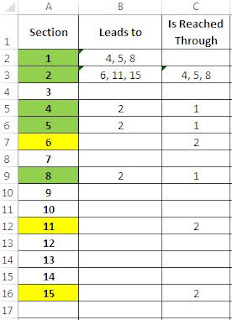
The first column just has each section in order. In some of my (as-yet unreleased) projects, I may break the story into different chapters, each with multiple numbered sections, such as Chapter 3.1, 3.2, 3.3, et cetera. In "In Enemy Territory," I think I'll just use numbered sections without chapters--probably between 100 and 150 sections.
Whenever I write and finish a section, I'll highlight it in green. Then I mark in column two which section or section the player can go to from there. For example, section 1 leads to sections 4, 5, or 8.
If a section has a branch that leads to it and has not yet been written, I highlight it in yellow. You can see that section 2 leads to section 6, 11, and 15, none of which have been written yet.
The third column tracks which section or sections lead to a particular branch. Section 1 is the only way to get to section 5, for example. This helps me if I ever need to backtrack--I can quickly follow the trail backwards, all the way to the beginning of the game if necessary.
You can see the first little bit of the story here. Bear in mind that this is an early draft. I have not, for example, figured out exactly how I want to present the encounters. Still, it might be interesting to see the process.
I work with two different documents--usually a Microsoft Word and a Microsoft Office document, although Google Docs works fine if I want to be able to work from any computer.
I use a spreadsheet to track each section in the gamebook.

The first column just has each section in order. In some of my (as-yet unreleased) projects, I may break the story into different chapters, each with multiple numbered sections, such as Chapter 3.1, 3.2, 3.3, et cetera. In "In Enemy Territory," I think I'll just use numbered sections without chapters--probably between 100 and 150 sections.
Whenever I write and finish a section, I'll highlight it in green. Then I mark in column two which section or section the player can go to from there. For example, section 1 leads to sections 4, 5, or 8.
If a section has a branch that leads to it and has not yet been written, I highlight it in yellow. You can see that section 2 leads to section 6, 11, and 15, none of which have been written yet.
The third column tracks which section or sections lead to a particular branch. Section 1 is the only way to get to section 5, for example. This helps me if I ever need to backtrack--I can quickly follow the trail backwards, all the way to the beginning of the game if necessary.
You can see the first little bit of the story here. Bear in mind that this is an early draft. I have not, for example, figured out exactly how I want to present the encounters. Still, it might be interesting to see the process.
Monday, August 19, 2013
Privyet, Russia!
I just discovered that this blog gets a lot of views from Russia. So, shout out to all my Russian readers! Я уверен, что вы все очень крутиe людей!
I lived in Russia for a couple years, so please don't hesitate to post any questions or comments по-русский.
I lived in Russia for a couple years, so please don't hesitate to post any questions or comments по-русский.
Sunday, August 18, 2013
Brainstorming, Continued: The First TESS Story
The basic mechanics of the game are starting to come together in my head. We're rapidly approaching the point where I need to start putting together a prototype. To do that, I need to put together a story for the player to play through.
I'd like the first TESS (The Expandable Solitaire System) story to put the player through a series of challenges that require different foci. I don't want everything to be combat-based, so that a combat-heavy deck can just waltz through it. That means there should be some hacking, some social encounters, perhaps some environmental challenges.
I'd also love to be able to incorporate three act structure into the narrative. This is a finely tuned narrative skeleton. When applied correctly, it gives the audience a compelling narrative with a satisfactory climax and denouement. The structure was used, completely on accident, to great success for several decades before film critics and theorists were finally able to nail down what the good films were doing that worked so well.

The first act of the story introduces the main characters and the world they inhabit. It also sets up the status quo. Now, the status quo may be lousy, such as in Star Wars--everybody is under the thumb of the Empire. Then there is an inciting incident, an event that compels the hero (or heroes) to action. Often, the hero has no idea that this action will change the course of his or her life. In Star Wars, Luke just goes off into the desert to find his uncle's rogue droid. Act one ends with a major plot point that propels the story into a new direction--Luke agrees to go with Ben Kenobi, Neo takes the red pill, the Avengers assemble to help Nick Fury, Dorothy sets off to see the Wizard, etc.
In the second act--which takes up the bulk of the story--there is a great deal of action as the story accelerates. The hero learns new skills and gains new allies. However, things keep getting worse and worse for the hero. At the midpoint, it seems that all hope is lost! The heroes are about to be smashed by a garbage compactor; the team has been scattered and/or killed; there's a traitor in the midst; things just could not get any worse! Then things begin to turn around. The heroes reunite. The major plot point from the first act is (usually) resolved--the princess is rescued, Loki's plan is discovered, Neo accepts his role in the Matrix and rescues Morpheus, and so forth. But a new plot point comes along that propels into the final climactic act--the Death Star is about to wipe out the Rebellion, Loki opens the portal, Neo decides to fight Agent Smith, Dorothy must confront the Wicked Witch.
The third and final act includes the final battle, where the hero must use the skills he or she has learned and rely on the new friends he or she has gained in order to triumph. Han saves Luke's bacon, then Luke uses the Force to blow up the Death Star. Neo becomes faster and stronger than an Agent. The Avengers work together to blow up the Chitauri forces and shut the portal. Dorothy is rescued by her friends and melts the witch.
So how can we incorporate these lessons into our TESS narrative? First, let's ask some questions about the characters and setting.
Who is the hero? Well, for the first TESS story, it should be the player. (There's room to play here, of course. It is entirely possible for the player to play Han to the story's Luke, but let's not meddle with the formula until after we've perfected the formula.) The player can be a robot, a cyborg, a human, or an uplift. That does make things a little difficult; each Persona has different goals, perspectives, and desires.
What does the main character want? Let's borrow from Serenity for a moment and say, "Freedom." No matter what Persona the player is using, the character's goal is to be free. He or she has a starship and a steady enough income to keep it running. He or she may have a dark past that is constantly trying to catch up with him or her--we'll see how things develop.
What problem does the main character have? Now we get to the inciting incident. Uh oh, there's a problem with the ship! Better land and get your ship repaired. But this is our inciting incident, after all; it can't be as easy as, "Okay, your ship will be fixed in an hour. That will be $100." So there's a problem with acquiring it. Maybe the city has recently been attacked? The port was raided, and the mechanic cannot repair your ship right away. But perhaps if you acquired the part you need? He tells you of the enemy's base, and says that if you bring back the part you need and some spare parts for him, he'll repair your ship free of charge.
You agree. That's the first plot point.
Time to sneak into an enemy base.
There will be some opportunities, at this point, to overcome some combat, hacking, and environmental challenges. The base is surrounded by an electric fence and you need to get passed it. You encounter some guards and need to take them down. The door is locked and you need to bypass it. The storage location for spare ship parts is hidden and you need to hack a computer terminal to find out where they are. Et cetera.
Now, we need a good midpoint. A classic one would be to have the hero captured. You're stripped of your equipment and thrown into a cell until the interrogator can arrive. You mount a daring escape, retrieve your equipment, steal the parts, and return to the port for your ship repairs. However, as the mechanic is working on your ship, your conscience nags at you. The things that were happening at the enemy base were despicable, inhuman. Can you really just leave these people to their fate?
Of course you can't! You decide to help out. That's the second plot point that drives us into the third act. You gear up and head out to bring down the enemies, using your knowledge of the layout of their base to pick them apart. Eventually, you reach Weak Point X and use it to wipe out the enemy base, but not before a final climactic battle with the Big Bad Guy and the Evil Mastermind.
Now, obviously, there are some important points to flesh out. Who are the enemies? What are they trying to accomplish? What does the hero see that spurns him or her to action? But this is a nice, simple plot outline that I can work with. It allows for several different types of encounters--Social, Combat, Hacking, and Environmental. It has a beginning, middle, and end, with a nice character arc thrown in for good measure. I can flesh out the details as I write the story, but this is a solid guide for what, in general, needs to happen.
Thanks for reading! I'm always up for a good discussion about films and the three-act structure, so feel free to post questions or comments.
I'd like the first TESS (The Expandable Solitaire System) story to put the player through a series of challenges that require different foci. I don't want everything to be combat-based, so that a combat-heavy deck can just waltz through it. That means there should be some hacking, some social encounters, perhaps some environmental challenges.
I'd also love to be able to incorporate three act structure into the narrative. This is a finely tuned narrative skeleton. When applied correctly, it gives the audience a compelling narrative with a satisfactory climax and denouement. The structure was used, completely on accident, to great success for several decades before film critics and theorists were finally able to nail down what the good films were doing that worked so well.
The first act of the story introduces the main characters and the world they inhabit. It also sets up the status quo. Now, the status quo may be lousy, such as in Star Wars--everybody is under the thumb of the Empire. Then there is an inciting incident, an event that compels the hero (or heroes) to action. Often, the hero has no idea that this action will change the course of his or her life. In Star Wars, Luke just goes off into the desert to find his uncle's rogue droid. Act one ends with a major plot point that propels the story into a new direction--Luke agrees to go with Ben Kenobi, Neo takes the red pill, the Avengers assemble to help Nick Fury, Dorothy sets off to see the Wizard, etc.
In the second act--which takes up the bulk of the story--there is a great deal of action as the story accelerates. The hero learns new skills and gains new allies. However, things keep getting worse and worse for the hero. At the midpoint, it seems that all hope is lost! The heroes are about to be smashed by a garbage compactor; the team has been scattered and/or killed; there's a traitor in the midst; things just could not get any worse! Then things begin to turn around. The heroes reunite. The major plot point from the first act is (usually) resolved--the princess is rescued, Loki's plan is discovered, Neo accepts his role in the Matrix and rescues Morpheus, and so forth. But a new plot point comes along that propels into the final climactic act--the Death Star is about to wipe out the Rebellion, Loki opens the portal, Neo decides to fight Agent Smith, Dorothy must confront the Wicked Witch.
The third and final act includes the final battle, where the hero must use the skills he or she has learned and rely on the new friends he or she has gained in order to triumph. Han saves Luke's bacon, then Luke uses the Force to blow up the Death Star. Neo becomes faster and stronger than an Agent. The Avengers work together to blow up the Chitauri forces and shut the portal. Dorothy is rescued by her friends and melts the witch.
So how can we incorporate these lessons into our TESS narrative? First, let's ask some questions about the characters and setting.
Who is the hero? Well, for the first TESS story, it should be the player. (There's room to play here, of course. It is entirely possible for the player to play Han to the story's Luke, but let's not meddle with the formula until after we've perfected the formula.) The player can be a robot, a cyborg, a human, or an uplift. That does make things a little difficult; each Persona has different goals, perspectives, and desires.
What does the main character want? Let's borrow from Serenity for a moment and say, "Freedom." No matter what Persona the player is using, the character's goal is to be free. He or she has a starship and a steady enough income to keep it running. He or she may have a dark past that is constantly trying to catch up with him or her--we'll see how things develop.
What problem does the main character have? Now we get to the inciting incident. Uh oh, there's a problem with the ship! Better land and get your ship repaired. But this is our inciting incident, after all; it can't be as easy as, "Okay, your ship will be fixed in an hour. That will be $100." So there's a problem with acquiring it. Maybe the city has recently been attacked? The port was raided, and the mechanic cannot repair your ship right away. But perhaps if you acquired the part you need? He tells you of the enemy's base, and says that if you bring back the part you need and some spare parts for him, he'll repair your ship free of charge.
You agree. That's the first plot point.
Time to sneak into an enemy base.
There will be some opportunities, at this point, to overcome some combat, hacking, and environmental challenges. The base is surrounded by an electric fence and you need to get passed it. You encounter some guards and need to take them down. The door is locked and you need to bypass it. The storage location for spare ship parts is hidden and you need to hack a computer terminal to find out where they are. Et cetera.
Now, we need a good midpoint. A classic one would be to have the hero captured. You're stripped of your equipment and thrown into a cell until the interrogator can arrive. You mount a daring escape, retrieve your equipment, steal the parts, and return to the port for your ship repairs. However, as the mechanic is working on your ship, your conscience nags at you. The things that were happening at the enemy base were despicable, inhuman. Can you really just leave these people to their fate?
Of course you can't! You decide to help out. That's the second plot point that drives us into the third act. You gear up and head out to bring down the enemies, using your knowledge of the layout of their base to pick them apart. Eventually, you reach Weak Point X and use it to wipe out the enemy base, but not before a final climactic battle with the Big Bad Guy and the Evil Mastermind.
Now, obviously, there are some important points to flesh out. Who are the enemies? What are they trying to accomplish? What does the hero see that spurns him or her to action? But this is a nice, simple plot outline that I can work with. It allows for several different types of encounters--Social, Combat, Hacking, and Environmental. It has a beginning, middle, and end, with a nice character arc thrown in for good measure. I can flesh out the details as I write the story, but this is a solid guide for what, in general, needs to happen.
Thanks for reading! I'm always up for a good discussion about films and the three-act structure, so feel free to post questions or comments.
Saturday, August 17, 2013
Brainstorming, Continued: Multiple Axes of Decision
The brainstorming phase of game creation is an exciting time. You get to throw dozens, perhaps hundreds of ideas against the wall and see which ones stick. (The cleanup afterwards isn't fun, but that's why they invented industrial-strength vacuums.)

A loose design goal I had for this game was to make it playable with just the rulebook, a story book, and the cards. The main reason for this goal was to cut down on the barrier between player and game. With print-and-play games, any addition of components just makes it that much harder for players to jump in and try the game. "Sorry, not only do you need to print and cut 200 cards, but you have to acquire 30 Eurocubes in assorted colors, and at least 10 dice of two different colors." That's a hassle. It's daunting to a lot of would-be PnPers. So I try to lower the barrier to entry to my PnP games as much as possible.
But, for the good of the game, I going to add at least one new dimension. Resources.
In previous brainstorming sessions, it was determined that the player would have a hand of cards, a deck of cards, and a discard pile as resources from which they could attempt to overcome various challenges. The problem with this is that it's binary. You either have the card(s) that you need or you do not. That's not an interesting game. ESPECIALLY when I'd like to give the player the chance to dig for the card(s) he or she needs.
What would make the game more interesting was to force the player to balance short- and long-term benefits. Sure, you can defeat that squad of mercenaries now, but will that leave you helpless in the robot boss fight later? Can you absorb the damage from the turret in order to save up for the final hacking challenge? This tension creates much more interesting game decisions. So how do I add this tension to the game?
The answer is to give the cards a cost in Resources. Yes, you can fire that Grenade Launcher now, but will that leave you enough cash to use your weapons later in the game? Sure, you can trade some intell to get a tool you need, but then what will you use to break into the data fortress? Those are the kinds of decisions I want the players to be making!
Currently, I think the game only needs two types of Resources: Cash and Data. Using physical Items will typically have a cost in Cash, while performing certain actions such as hacking or convincing might require Data. Some cards might require both, and the occasional card may cost neither. The important thing is that the player will now have multiple axes of decision. It will not just be a case of having the right cards, but using those cards effectively to maintain a pool of Resources.
The downside to this is that the player will need a way to track his or her Resources, whether it be pen and paper, a smart phone app, an Excel sheet, poker chips, or whatever they have on hand. It increases the game's footprint (more space require on the table in order to play) and ratchets up the barrier to entry, if only slightly. Still, I think this will be an important step in making the kind of dynamic and interesting solitaire game system that this needs to be.
I am also considering a third layer, in addition to cards and Resources: Actions. During an encounter, the player would be able to perform X number of Actions, and then the encounter would "act." This may mean doing something detrimental to the player, such as forcing him or her to discard cards or lose Resources, or it could just advance some sort of timer--a countdown to something really bad happening. This has the added benefit of balancing out the ability to discard a card and draw a card. If the player can only take, say, three actions before the encounter acts, it's potentially a lot more costly to need five actions just to find the cards necessary to guarantee success. More importantly, this would give encounters a more dynamic feel, with a "back-and-forth" dynamic happening between the player and the game's AI.
This would mean that encounters would be more difficult to create and balance. That's more work on the part of the designer, and I'm not certain yet if the game needs this sort of dynamic. But it does make for more interesting outcomes to the encounters beyond simply pass/fail. And it would give the player another axis of decision, and another knob for the designer to tweak while trying to balance the game and increase the tension and fun. I'll keep it on the back burner for now, but I like the idea.
Sunday, August 11, 2013
Brainstorming, Continued: Building a Skeleton
With this contest, I'd really like to show my design methods as much as possible. Not only do I think that it might--MIGHT, mind you--be interesting and instructive to others, but it will be a good resource for myself. I can analyze what I do and why I do it, which will hopefully lead to improvements in my own methodology.
As demonstrated in the previous post, my preferred method is to brainstorm a variety of ideas, then use deductive logic to eliminate the weaker ideas. We now have a very basic shape or outline of the game. It's time now to build a skeleton. We'll put some meat on the bones later, but for now we just want a good sturdy structure on which to build.
The game requires the construction of three major components: the rules, the stories, and the customizable decks. The game cannot function without all three components, so we must always keep these three aspects in mind as we put our skeleton together.
Before the player begins a game, he or she must construct a deck. (I'm assuming they have gone through the process of building or purchasing the components and are familiar with the rules.) Of what does deckbuilding consist?
Well, first they must select a Persona. I find the idea of four separate and distinct Personas to be very balanced and pleasing. This means that there should be at least four different thematic strategies for approaching the game. Let's explore those briefly.

As demonstrated in the previous post, my preferred method is to brainstorm a variety of ideas, then use deductive logic to eliminate the weaker ideas. We now have a very basic shape or outline of the game. It's time now to build a skeleton. We'll put some meat on the bones later, but for now we just want a good sturdy structure on which to build.
The game requires the construction of three major components: the rules, the stories, and the customizable decks. The game cannot function without all three components, so we must always keep these three aspects in mind as we put our skeleton together.
Before the player begins a game, he or she must construct a deck. (I'm assuming they have gone through the process of building or purchasing the components and are familiar with the rules.) Of what does deckbuilding consist?
Well, first they must select a Persona. I find the idea of four separate and distinct Personas to be very balanced and pleasing. This means that there should be at least four different thematic strategies for approaching the game. Let's explore those briefly.
- Human - Humans are (relatively) physically weak, with shaky limbs and poor eyesight. This means that they struggle in combat unless they have the correct tools for the job. However, they are very good at ACQUIRING the correct tools for the job. Human cards should focus on digging through the deck, manipulating cards in hand, sifting through the discard pile, and maybe even pulling cards back from exile. Humans are innovators, using creativity and planning to overcome the obstacles they encounter. They are also very adept at social challenges, particularly since they almost always deal with fellow humans, or with creatures that have human-like emotions and motivations.
- Robot - Robots are quick, calculating, and equipped with many different tools to get them through their tasks. They particularly excel at hacking and electronic warfare. They are also very good with guns, favoring long-range attacks over melee combat (where their fragile joints are a liability). They suffer socially, however, being handicapped by their historical status as slaves and servants, by their difficulty in understanding human emotions and motivations, and by their general appearance and demeanor. Robot cards should focus on different tools and settings to uplink with or disassemble anything that gives them trouble.
- Cyborg - Cyborgs are tough, powerful, with vast stores of knowledge they can access. They are often equipped for hacking, but it is more dangerous for them then for robots--electronic countermeasures can sometimes fry a cyborg's brain. Their enhanced speed and strength make them excellent at hand-to-hand combat. They can struggle socially in some circles--not all sentient beings approve of man/machine hybrids. Cyborg cards should focus on brute strength, bashing straight through trouble with little regard to consequences; also cards that can mitigate potential consequences, to represent the cyborg's toughness.
- Uplift - Uplifts are intelligent, yet retain their animal senses and instincts. It would be thematically useful to decide on a particular species for this Persona, such as dogs, cats, chimps, or pigs, but I don't want to commit to anything just yet. Uplifts are smaller than humans (or robots or cyborgs), making it easier for them to utilize the environment to their advantage. Uplift cards should focus on stealth play--hiding in small spaces, avoiding detection, using maintenance tunnels and air ducts to reach objectives, etc. Uplifts struggle with hacking, as the interfaces are always designed for human use. They can struggle in combat against prepared opponents, but stealthy attacks often allow them to subdue threats without a fight.
That seems good. Four different strategies--deck manipulation, finesse, brute force, and stealth. Hopefully they will combine well to create a wide variety of deck types.
Now, once the decks are crafted and the game has begun, most of the decision-making will take place during encounters. So we really need to get those RIGHT. What do encounters look like? What sort of information is presented to the player? What tools will they have at their disposal to overcome the encounters?
The current plan is to have semi-linear stories that introduce random encounters. Let's brainstorm some RE ideas to make sure that we can include encounters that play to each Persona's strengths and weaknesses.
- Locked Door
- Machine Gun Turret
- Malfunctioning Bridge Extension
- Robot Sentry
- Sniper on the Ridge
- Guard Post
- Angry Mob
- Crafty Salesman
- Indifferent Pilot
- Bounty Hunters
- Data Storage Unit
Well, the good news is, I can come up with plenty of ideas for problems that the player must overcome. The BETTER news is that the problems tend to break down into one or more categories:
- Combat - The player must fight someone or something. They may not need to kill or destroy their opponent, however; sometimes they can merely subdue it. Since I'm very much a life-affirming person, I like the idea of providing cards that accommodate a no-kill strategy. Stun guns and tranq darts all the way!
- Hacking - Sometimes the player must interact with computer terminals. Maybe they have to hack some bots, turrets, or security cameras. Maybe they have to dig up some information from a data storage unit. Maybe they have to scramble the coordinates before some missiles are launched. There are a lot of interesting ways this could be incorporated into the story.
- Social - Occasionally the player will have to deal with people, not all of whom will want to deal with them. Maybe they need a component or weapon that they can only get from a black market dealer. Maybe they need to calm an angry mob before someone gets hurt. Maybe they must bribe a pilot to take them somewhere discretely. Whatever it is, some Personas will have an easier time than others.
- Environmental - The door is locked! The bulkhead is leaking! The bridge won't extend! The forest is freaking ON FIRE! There are a lot of ways to force the player to overcome obstacles presented by the environment, some of which will require some fast-thinking, some of which will require brute force.
It's looking more and more like some of the encounters within the stories will or should be pre-scripted. They will be the same every time. I'm okay with that. It's a good way to provide narrative structure. There can still, of course, be plenty of random encounters, as well.
It's interesting that there are four Personas, and four encounter categories. This makes me wonder if perhaps the different Personas are adept at different categories. Let's see if we can rank each Persona and how good it is at dealing with the different types of encounters.

That seems to work, mostly. Some of those numbers are a little difficult to justify, though. For example, why is the Cyborg Persona the weakest at overcoming Environmental obstacles? Busting through locked doors or climbing up cliffs shouldn't be difficult for a cyborg. I do think that it's appropriate for Humans to not be great at hacking--after all, the average untrained human would have a hard time interfacing with and manipulating unfamiliar computer systems.
Still, this does give us a rough guide of what we can expect. Perhaps, for balancing purposes, the important thing should be that each Persona's total should be 10. So the Cyborg might actually be Combat 3, Hacking 3, Social 2, Environment 2. The Uplift might be Combat 1, Hacking 1, Social 4, Environment 4. Et cetera. But this does illustrate the relative strengths and weaknesses of the Personas. That will come in handy when we start brainstorming the actual cards.
This was a very useful session! I think the next step will be to outline a rough story, including some encounters, and then working on cards for each Persona. Then we can stress test the system and start hammering out the rules.
Subscribe to:
Posts (Atom)