The world has changed since the Awakening.
Each night, billions of people take specially-designed sedatives to put themselves to sleep. They can rest peacefully, knowing that they are safe. But there are some who, either by choice or by circumstance, do not take any sedatives. Such people become Conduits--channels through which nightmarish creatures can leak through from the dream world into our own.
Having accidentally orphaned yourself during the Awakening, you have vowed to capture or destroy all the dream creatures that slip through.
The world has changed since the Awakening. It has given you a purpose.
Dream Hunter is a solitaire game of investigation and battle as you hunt down the creatures released from others' dreams. Follow the clues, then capture or destroy the dream before it turns the world into a nightmare.
Likely card-based, with a small to medium-sized board.
Showing posts with label Solitaire Game. Show all posts
Showing posts with label Solitaire Game. Show all posts
Friday, October 25, 2013


Wednesday, September 18, 2013
Game Concept: The Fall
This has been a frustratingly busy semester for me. I'm taking several intensive courses that require a great deal of reading and thoughtful discussion of the texts. My wife's writing/editing job ebbs and flows throughout the year and is currently at an ebb, so I've had to put in more hours at my work to make up the difference. Plus, my wife is taking an insane number of advanced Greek and Latin classes, which keep her busy busy busy, leaving me to shoulder much of the daily house chores--dishes, cooking, laundry, trash, etc. I don't mind in the slightest, but all this means that I rarely have a confluence of both time and the energy for creative projects.
The TESS rules and module are unlikely to be ready before the 2013 Solitaire PnP Design Contest deadline. I'm okay with that. It's a big game that will need a lot of testing to make sure that the core mechanics work, and then even more testing to find a good balance. If it needs time to percolate, all the better for the game.
This has given me a lot of time to ponder about other concepts I have been keeping in my back pocket. One of them is The Fall. This began as a concept for a video game JRPG several years ago--the main character goes on a quest, and collects new friends and allies and new equipment and abilities along the way. I recently sketched out some ideas in my head that MIGHT allow this game to see daylight as a tabletop game.
THEME
The main character is climbing across a huge chasm when his line snaps and he plummets deep into the earth. Instead of splattering onto rock or nosediving into lava, however, he slips through a magic mortal that transports him into a giant underground world. He gets entangled in the political intrigue of two warring nations when it is discovered that he is entirely immune to all forms of magic. To get back home, he must join with one of these enchanted nations, lead a team into enemy territory, and gather the components needed for the queen to build him a machine to take him to the surface.
CHARACTERS
--A climbing and spelunking enthusiast from our modern world who, for whatever reason, is completely immune to magic.
--An enchantress/queen struggling to protect her nation from invasion.
--A cunning sorceress/queen with a thirst for destruction.
--A young girl with an incredible talent for sorcery.
--A warrior/scholar devoted to protecting the young girl.
--An exiled skreeling (sort of a goblin-like creature) looking for new friends and a new home.
--A mechanical man with a burning desire to be useful.
--An armored cave bear on a quest to avenge her slain cubs.
MECHANICS
This is where much of my thoughts have been these last few days. I recall playing Final Fantasy X years ago and admiring a great many things about the game's design. One neat thing that the game did was give each hero a unique special move with a powerful effect, with each move requiring the player to perform a different mini-game. With one character, you had to rotate the thumbstick as many times as possible within a short time limit. With another, you had to pause a slider within a small area as it moved back and forth. With yet another, you had to play a game of slots and try to get three of a kind for maximum effect.
This got me to thinking--what if each character in The Fall had a unique battle mechanic? Once the player has a full party, he or she can select the three characters (or the three mini-games) he or she enjoys the most and bring them into the combat situations. One character might use a Yahtzee-style dice mechanic. One might require the player to flip a coin a number of times. One may use the strike/maneuver poker card mechanic from my own Wings of Lightning. Still another may use a dexterity mechanic; designer Jessey Wright would like that. The idea would be to use components that a typical gamer can be expected to have around the house to create quick yet interesting mini-challenges for each character's combat abilities.
To simulate the idea of random encounters, I would provide the player with a map showing the number of spaces between the different key locations. Each time the player moves the party to a new space, he or she must roll on a chart to see if he or she has an encounter, and if so, with what.
The heroes and all enemies they face would be given various stats, include Speed ratings. The player would activate each combatant's abilities in order from highest Speed to lowest. Particularly fast characters may get two or even three Speeds, indicating that they are able to attack multiple times in a round. For example, a character may have a rating of 8 and 3. This means that the character would attack before anyone else with a Speed rating lower than 8, and then again after everyone with a Speed rating higher than 3.
Enemies could be programmed with different behaviors to provide the player with interesting tactical choices. Some of them might target the character with the lowest health. Others would attack the character that most recently performed an attack. Still others would be have a list of the characters and would attack starting from the top of the list, according to which characters were in combat. And others would randomize their attacks with only a small amount of predictability. This would keep the player on his or her toes and provide him or her with interesting decisions about when to attack, when to heal, when to defend, et cetera.
I have no idea when I'll be able to work on this game, but I wanted to get my thoughts on paper. I have to graduate eventually, and when I do, you can bet that I'll be putting my unchained brain power into all sorts of creative endeavors like this!
The TESS rules and module are unlikely to be ready before the 2013 Solitaire PnP Design Contest deadline. I'm okay with that. It's a big game that will need a lot of testing to make sure that the core mechanics work, and then even more testing to find a good balance. If it needs time to percolate, all the better for the game.
This has given me a lot of time to ponder about other concepts I have been keeping in my back pocket. One of them is The Fall. This began as a concept for a video game JRPG several years ago--the main character goes on a quest, and collects new friends and allies and new equipment and abilities along the way. I recently sketched out some ideas in my head that MIGHT allow this game to see daylight as a tabletop game.
THEME
The main character is climbing across a huge chasm when his line snaps and he plummets deep into the earth. Instead of splattering onto rock or nosediving into lava, however, he slips through a magic mortal that transports him into a giant underground world. He gets entangled in the political intrigue of two warring nations when it is discovered that he is entirely immune to all forms of magic. To get back home, he must join with one of these enchanted nations, lead a team into enemy territory, and gather the components needed for the queen to build him a machine to take him to the surface.
CHARACTERS
--A climbing and spelunking enthusiast from our modern world who, for whatever reason, is completely immune to magic.
--An enchantress/queen struggling to protect her nation from invasion.
--A cunning sorceress/queen with a thirst for destruction.
--A young girl with an incredible talent for sorcery.
--A warrior/scholar devoted to protecting the young girl.
--An exiled skreeling (sort of a goblin-like creature) looking for new friends and a new home.
--A mechanical man with a burning desire to be useful.
--An armored cave bear on a quest to avenge her slain cubs.
MECHANICS
This is where much of my thoughts have been these last few days. I recall playing Final Fantasy X years ago and admiring a great many things about the game's design. One neat thing that the game did was give each hero a unique special move with a powerful effect, with each move requiring the player to perform a different mini-game. With one character, you had to rotate the thumbstick as many times as possible within a short time limit. With another, you had to pause a slider within a small area as it moved back and forth. With yet another, you had to play a game of slots and try to get three of a kind for maximum effect.
This got me to thinking--what if each character in The Fall had a unique battle mechanic? Once the player has a full party, he or she can select the three characters (or the three mini-games) he or she enjoys the most and bring them into the combat situations. One character might use a Yahtzee-style dice mechanic. One might require the player to flip a coin a number of times. One may use the strike/maneuver poker card mechanic from my own Wings of Lightning. Still another may use a dexterity mechanic; designer Jessey Wright would like that. The idea would be to use components that a typical gamer can be expected to have around the house to create quick yet interesting mini-challenges for each character's combat abilities.
To simulate the idea of random encounters, I would provide the player with a map showing the number of spaces between the different key locations. Each time the player moves the party to a new space, he or she must roll on a chart to see if he or she has an encounter, and if so, with what.
The heroes and all enemies they face would be given various stats, include Speed ratings. The player would activate each combatant's abilities in order from highest Speed to lowest. Particularly fast characters may get two or even three Speeds, indicating that they are able to attack multiple times in a round. For example, a character may have a rating of 8 and 3. This means that the character would attack before anyone else with a Speed rating lower than 8, and then again after everyone with a Speed rating higher than 3.
Enemies could be programmed with different behaviors to provide the player with interesting tactical choices. Some of them might target the character with the lowest health. Others would attack the character that most recently performed an attack. Still others would be have a list of the characters and would attack starting from the top of the list, according to which characters were in combat. And others would randomize their attacks with only a small amount of predictability. This would keep the player on his or her toes and provide him or her with interesting decisions about when to attack, when to heal, when to defend, et cetera.
I have no idea when I'll be able to work on this game, but I wanted to get my thoughts on paper. I have to graduate eventually, and when I do, you can bet that I'll be putting my unchained brain power into all sorts of creative endeavors like this!
Sunday, August 25, 2013
TESS: In Enemy Territory
I've begun working on the first TESS story module, tentatively titled "In Enemy Territory." I thought I'd share my process for creating these type of branching-path gamebooks. It's probably not the most efficient way to do it, but it's worked for me on multiple projects.
I work with two different documents--usually a Microsoft Word and a Microsoft Office document, although Google Docs works fine if I want to be able to work from any computer.
I use a spreadsheet to track each section in the gamebook.
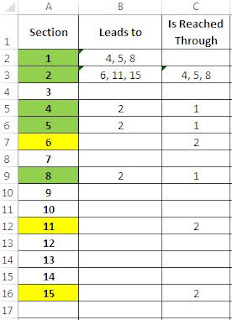
The first column just has each section in order. In some of my (as-yet unreleased) projects, I may break the story into different chapters, each with multiple numbered sections, such as Chapter 3.1, 3.2, 3.3, et cetera. In "In Enemy Territory," I think I'll just use numbered sections without chapters--probably between 100 and 150 sections.
Whenever I write and finish a section, I'll highlight it in green. Then I mark in column two which section or section the player can go to from there. For example, section 1 leads to sections 4, 5, or 8.
If a section has a branch that leads to it and has not yet been written, I highlight it in yellow. You can see that section 2 leads to section 6, 11, and 15, none of which have been written yet.
The third column tracks which section or sections lead to a particular branch. Section 1 is the only way to get to section 5, for example. This helps me if I ever need to backtrack--I can quickly follow the trail backwards, all the way to the beginning of the game if necessary.
You can see the first little bit of the story here. Bear in mind that this is an early draft. I have not, for example, figured out exactly how I want to present the encounters. Still, it might be interesting to see the process.
I work with two different documents--usually a Microsoft Word and a Microsoft Office document, although Google Docs works fine if I want to be able to work from any computer.
I use a spreadsheet to track each section in the gamebook.

The first column just has each section in order. In some of my (as-yet unreleased) projects, I may break the story into different chapters, each with multiple numbered sections, such as Chapter 3.1, 3.2, 3.3, et cetera. In "In Enemy Territory," I think I'll just use numbered sections without chapters--probably between 100 and 150 sections.
Whenever I write and finish a section, I'll highlight it in green. Then I mark in column two which section or section the player can go to from there. For example, section 1 leads to sections 4, 5, or 8.
If a section has a branch that leads to it and has not yet been written, I highlight it in yellow. You can see that section 2 leads to section 6, 11, and 15, none of which have been written yet.
The third column tracks which section or sections lead to a particular branch. Section 1 is the only way to get to section 5, for example. This helps me if I ever need to backtrack--I can quickly follow the trail backwards, all the way to the beginning of the game if necessary.
You can see the first little bit of the story here. Bear in mind that this is an early draft. I have not, for example, figured out exactly how I want to present the encounters. Still, it might be interesting to see the process.
Sunday, August 18, 2013
Brainstorming, Continued: The First TESS Story
The basic mechanics of the game are starting to come together in my head. We're rapidly approaching the point where I need to start putting together a prototype. To do that, I need to put together a story for the player to play through.
I'd like the first TESS (The Expandable Solitaire System) story to put the player through a series of challenges that require different foci. I don't want everything to be combat-based, so that a combat-heavy deck can just waltz through it. That means there should be some hacking, some social encounters, perhaps some environmental challenges.
I'd also love to be able to incorporate three act structure into the narrative. This is a finely tuned narrative skeleton. When applied correctly, it gives the audience a compelling narrative with a satisfactory climax and denouement. The structure was used, completely on accident, to great success for several decades before film critics and theorists were finally able to nail down what the good films were doing that worked so well.

The first act of the story introduces the main characters and the world they inhabit. It also sets up the status quo. Now, the status quo may be lousy, such as in Star Wars--everybody is under the thumb of the Empire. Then there is an inciting incident, an event that compels the hero (or heroes) to action. Often, the hero has no idea that this action will change the course of his or her life. In Star Wars, Luke just goes off into the desert to find his uncle's rogue droid. Act one ends with a major plot point that propels the story into a new direction--Luke agrees to go with Ben Kenobi, Neo takes the red pill, the Avengers assemble to help Nick Fury, Dorothy sets off to see the Wizard, etc.
In the second act--which takes up the bulk of the story--there is a great deal of action as the story accelerates. The hero learns new skills and gains new allies. However, things keep getting worse and worse for the hero. At the midpoint, it seems that all hope is lost! The heroes are about to be smashed by a garbage compactor; the team has been scattered and/or killed; there's a traitor in the midst; things just could not get any worse! Then things begin to turn around. The heroes reunite. The major plot point from the first act is (usually) resolved--the princess is rescued, Loki's plan is discovered, Neo accepts his role in the Matrix and rescues Morpheus, and so forth. But a new plot point comes along that propels into the final climactic act--the Death Star is about to wipe out the Rebellion, Loki opens the portal, Neo decides to fight Agent Smith, Dorothy must confront the Wicked Witch.
The third and final act includes the final battle, where the hero must use the skills he or she has learned and rely on the new friends he or she has gained in order to triumph. Han saves Luke's bacon, then Luke uses the Force to blow up the Death Star. Neo becomes faster and stronger than an Agent. The Avengers work together to blow up the Chitauri forces and shut the portal. Dorothy is rescued by her friends and melts the witch.
So how can we incorporate these lessons into our TESS narrative? First, let's ask some questions about the characters and setting.
Who is the hero? Well, for the first TESS story, it should be the player. (There's room to play here, of course. It is entirely possible for the player to play Han to the story's Luke, but let's not meddle with the formula until after we've perfected the formula.) The player can be a robot, a cyborg, a human, or an uplift. That does make things a little difficult; each Persona has different goals, perspectives, and desires.
What does the main character want? Let's borrow from Serenity for a moment and say, "Freedom." No matter what Persona the player is using, the character's goal is to be free. He or she has a starship and a steady enough income to keep it running. He or she may have a dark past that is constantly trying to catch up with him or her--we'll see how things develop.
What problem does the main character have? Now we get to the inciting incident. Uh oh, there's a problem with the ship! Better land and get your ship repaired. But this is our inciting incident, after all; it can't be as easy as, "Okay, your ship will be fixed in an hour. That will be $100." So there's a problem with acquiring it. Maybe the city has recently been attacked? The port was raided, and the mechanic cannot repair your ship right away. But perhaps if you acquired the part you need? He tells you of the enemy's base, and says that if you bring back the part you need and some spare parts for him, he'll repair your ship free of charge.
You agree. That's the first plot point.
Time to sneak into an enemy base.
There will be some opportunities, at this point, to overcome some combat, hacking, and environmental challenges. The base is surrounded by an electric fence and you need to get passed it. You encounter some guards and need to take them down. The door is locked and you need to bypass it. The storage location for spare ship parts is hidden and you need to hack a computer terminal to find out where they are. Et cetera.
Now, we need a good midpoint. A classic one would be to have the hero captured. You're stripped of your equipment and thrown into a cell until the interrogator can arrive. You mount a daring escape, retrieve your equipment, steal the parts, and return to the port for your ship repairs. However, as the mechanic is working on your ship, your conscience nags at you. The things that were happening at the enemy base were despicable, inhuman. Can you really just leave these people to their fate?
Of course you can't! You decide to help out. That's the second plot point that drives us into the third act. You gear up and head out to bring down the enemies, using your knowledge of the layout of their base to pick them apart. Eventually, you reach Weak Point X and use it to wipe out the enemy base, but not before a final climactic battle with the Big Bad Guy and the Evil Mastermind.
Now, obviously, there are some important points to flesh out. Who are the enemies? What are they trying to accomplish? What does the hero see that spurns him or her to action? But this is a nice, simple plot outline that I can work with. It allows for several different types of encounters--Social, Combat, Hacking, and Environmental. It has a beginning, middle, and end, with a nice character arc thrown in for good measure. I can flesh out the details as I write the story, but this is a solid guide for what, in general, needs to happen.
Thanks for reading! I'm always up for a good discussion about films and the three-act structure, so feel free to post questions or comments.
I'd like the first TESS (The Expandable Solitaire System) story to put the player through a series of challenges that require different foci. I don't want everything to be combat-based, so that a combat-heavy deck can just waltz through it. That means there should be some hacking, some social encounters, perhaps some environmental challenges.
I'd also love to be able to incorporate three act structure into the narrative. This is a finely tuned narrative skeleton. When applied correctly, it gives the audience a compelling narrative with a satisfactory climax and denouement. The structure was used, completely on accident, to great success for several decades before film critics and theorists were finally able to nail down what the good films were doing that worked so well.
The first act of the story introduces the main characters and the world they inhabit. It also sets up the status quo. Now, the status quo may be lousy, such as in Star Wars--everybody is under the thumb of the Empire. Then there is an inciting incident, an event that compels the hero (or heroes) to action. Often, the hero has no idea that this action will change the course of his or her life. In Star Wars, Luke just goes off into the desert to find his uncle's rogue droid. Act one ends with a major plot point that propels the story into a new direction--Luke agrees to go with Ben Kenobi, Neo takes the red pill, the Avengers assemble to help Nick Fury, Dorothy sets off to see the Wizard, etc.
In the second act--which takes up the bulk of the story--there is a great deal of action as the story accelerates. The hero learns new skills and gains new allies. However, things keep getting worse and worse for the hero. At the midpoint, it seems that all hope is lost! The heroes are about to be smashed by a garbage compactor; the team has been scattered and/or killed; there's a traitor in the midst; things just could not get any worse! Then things begin to turn around. The heroes reunite. The major plot point from the first act is (usually) resolved--the princess is rescued, Loki's plan is discovered, Neo accepts his role in the Matrix and rescues Morpheus, and so forth. But a new plot point comes along that propels into the final climactic act--the Death Star is about to wipe out the Rebellion, Loki opens the portal, Neo decides to fight Agent Smith, Dorothy must confront the Wicked Witch.
The third and final act includes the final battle, where the hero must use the skills he or she has learned and rely on the new friends he or she has gained in order to triumph. Han saves Luke's bacon, then Luke uses the Force to blow up the Death Star. Neo becomes faster and stronger than an Agent. The Avengers work together to blow up the Chitauri forces and shut the portal. Dorothy is rescued by her friends and melts the witch.
So how can we incorporate these lessons into our TESS narrative? First, let's ask some questions about the characters and setting.
Who is the hero? Well, for the first TESS story, it should be the player. (There's room to play here, of course. It is entirely possible for the player to play Han to the story's Luke, but let's not meddle with the formula until after we've perfected the formula.) The player can be a robot, a cyborg, a human, or an uplift. That does make things a little difficult; each Persona has different goals, perspectives, and desires.
What does the main character want? Let's borrow from Serenity for a moment and say, "Freedom." No matter what Persona the player is using, the character's goal is to be free. He or she has a starship and a steady enough income to keep it running. He or she may have a dark past that is constantly trying to catch up with him or her--we'll see how things develop.
What problem does the main character have? Now we get to the inciting incident. Uh oh, there's a problem with the ship! Better land and get your ship repaired. But this is our inciting incident, after all; it can't be as easy as, "Okay, your ship will be fixed in an hour. That will be $100." So there's a problem with acquiring it. Maybe the city has recently been attacked? The port was raided, and the mechanic cannot repair your ship right away. But perhaps if you acquired the part you need? He tells you of the enemy's base, and says that if you bring back the part you need and some spare parts for him, he'll repair your ship free of charge.
You agree. That's the first plot point.
Time to sneak into an enemy base.
There will be some opportunities, at this point, to overcome some combat, hacking, and environmental challenges. The base is surrounded by an electric fence and you need to get passed it. You encounter some guards and need to take them down. The door is locked and you need to bypass it. The storage location for spare ship parts is hidden and you need to hack a computer terminal to find out where they are. Et cetera.
Now, we need a good midpoint. A classic one would be to have the hero captured. You're stripped of your equipment and thrown into a cell until the interrogator can arrive. You mount a daring escape, retrieve your equipment, steal the parts, and return to the port for your ship repairs. However, as the mechanic is working on your ship, your conscience nags at you. The things that were happening at the enemy base were despicable, inhuman. Can you really just leave these people to their fate?
Of course you can't! You decide to help out. That's the second plot point that drives us into the third act. You gear up and head out to bring down the enemies, using your knowledge of the layout of their base to pick them apart. Eventually, you reach Weak Point X and use it to wipe out the enemy base, but not before a final climactic battle with the Big Bad Guy and the Evil Mastermind.
Now, obviously, there are some important points to flesh out. Who are the enemies? What are they trying to accomplish? What does the hero see that spurns him or her to action? But this is a nice, simple plot outline that I can work with. It allows for several different types of encounters--Social, Combat, Hacking, and Environmental. It has a beginning, middle, and end, with a nice character arc thrown in for good measure. I can flesh out the details as I write the story, but this is a solid guide for what, in general, needs to happen.
Thanks for reading! I'm always up for a good discussion about films and the three-act structure, so feel free to post questions or comments.
Saturday, August 17, 2013
Brainstorming, Continued: Multiple Axes of Decision
The brainstorming phase of game creation is an exciting time. You get to throw dozens, perhaps hundreds of ideas against the wall and see which ones stick. (The cleanup afterwards isn't fun, but that's why they invented industrial-strength vacuums.)

A loose design goal I had for this game was to make it playable with just the rulebook, a story book, and the cards. The main reason for this goal was to cut down on the barrier between player and game. With print-and-play games, any addition of components just makes it that much harder for players to jump in and try the game. "Sorry, not only do you need to print and cut 200 cards, but you have to acquire 30 Eurocubes in assorted colors, and at least 10 dice of two different colors." That's a hassle. It's daunting to a lot of would-be PnPers. So I try to lower the barrier to entry to my PnP games as much as possible.
But, for the good of the game, I going to add at least one new dimension. Resources.
In previous brainstorming sessions, it was determined that the player would have a hand of cards, a deck of cards, and a discard pile as resources from which they could attempt to overcome various challenges. The problem with this is that it's binary. You either have the card(s) that you need or you do not. That's not an interesting game. ESPECIALLY when I'd like to give the player the chance to dig for the card(s) he or she needs.
What would make the game more interesting was to force the player to balance short- and long-term benefits. Sure, you can defeat that squad of mercenaries now, but will that leave you helpless in the robot boss fight later? Can you absorb the damage from the turret in order to save up for the final hacking challenge? This tension creates much more interesting game decisions. So how do I add this tension to the game?
The answer is to give the cards a cost in Resources. Yes, you can fire that Grenade Launcher now, but will that leave you enough cash to use your weapons later in the game? Sure, you can trade some intell to get a tool you need, but then what will you use to break into the data fortress? Those are the kinds of decisions I want the players to be making!
Currently, I think the game only needs two types of Resources: Cash and Data. Using physical Items will typically have a cost in Cash, while performing certain actions such as hacking or convincing might require Data. Some cards might require both, and the occasional card may cost neither. The important thing is that the player will now have multiple axes of decision. It will not just be a case of having the right cards, but using those cards effectively to maintain a pool of Resources.
The downside to this is that the player will need a way to track his or her Resources, whether it be pen and paper, a smart phone app, an Excel sheet, poker chips, or whatever they have on hand. It increases the game's footprint (more space require on the table in order to play) and ratchets up the barrier to entry, if only slightly. Still, I think this will be an important step in making the kind of dynamic and interesting solitaire game system that this needs to be.
I am also considering a third layer, in addition to cards and Resources: Actions. During an encounter, the player would be able to perform X number of Actions, and then the encounter would "act." This may mean doing something detrimental to the player, such as forcing him or her to discard cards or lose Resources, or it could just advance some sort of timer--a countdown to something really bad happening. This has the added benefit of balancing out the ability to discard a card and draw a card. If the player can only take, say, three actions before the encounter acts, it's potentially a lot more costly to need five actions just to find the cards necessary to guarantee success. More importantly, this would give encounters a more dynamic feel, with a "back-and-forth" dynamic happening between the player and the game's AI.
This would mean that encounters would be more difficult to create and balance. That's more work on the part of the designer, and I'm not certain yet if the game needs this sort of dynamic. But it does make for more interesting outcomes to the encounters beyond simply pass/fail. And it would give the player another axis of decision, and another knob for the designer to tweak while trying to balance the game and increase the tension and fun. I'll keep it on the back burner for now, but I like the idea.
Sunday, August 11, 2013
Brainstorming, Continued: Building a Skeleton
With this contest, I'd really like to show my design methods as much as possible. Not only do I think that it might--MIGHT, mind you--be interesting and instructive to others, but it will be a good resource for myself. I can analyze what I do and why I do it, which will hopefully lead to improvements in my own methodology.
As demonstrated in the previous post, my preferred method is to brainstorm a variety of ideas, then use deductive logic to eliminate the weaker ideas. We now have a very basic shape or outline of the game. It's time now to build a skeleton. We'll put some meat on the bones later, but for now we just want a good sturdy structure on which to build.
The game requires the construction of three major components: the rules, the stories, and the customizable decks. The game cannot function without all three components, so we must always keep these three aspects in mind as we put our skeleton together.
Before the player begins a game, he or she must construct a deck. (I'm assuming they have gone through the process of building or purchasing the components and are familiar with the rules.) Of what does deckbuilding consist?
Well, first they must select a Persona. I find the idea of four separate and distinct Personas to be very balanced and pleasing. This means that there should be at least four different thematic strategies for approaching the game. Let's explore those briefly.

As demonstrated in the previous post, my preferred method is to brainstorm a variety of ideas, then use deductive logic to eliminate the weaker ideas. We now have a very basic shape or outline of the game. It's time now to build a skeleton. We'll put some meat on the bones later, but for now we just want a good sturdy structure on which to build.
The game requires the construction of three major components: the rules, the stories, and the customizable decks. The game cannot function without all three components, so we must always keep these three aspects in mind as we put our skeleton together.
Before the player begins a game, he or she must construct a deck. (I'm assuming they have gone through the process of building or purchasing the components and are familiar with the rules.) Of what does deckbuilding consist?
Well, first they must select a Persona. I find the idea of four separate and distinct Personas to be very balanced and pleasing. This means that there should be at least four different thematic strategies for approaching the game. Let's explore those briefly.
- Human - Humans are (relatively) physically weak, with shaky limbs and poor eyesight. This means that they struggle in combat unless they have the correct tools for the job. However, they are very good at ACQUIRING the correct tools for the job. Human cards should focus on digging through the deck, manipulating cards in hand, sifting through the discard pile, and maybe even pulling cards back from exile. Humans are innovators, using creativity and planning to overcome the obstacles they encounter. They are also very adept at social challenges, particularly since they almost always deal with fellow humans, or with creatures that have human-like emotions and motivations.
- Robot - Robots are quick, calculating, and equipped with many different tools to get them through their tasks. They particularly excel at hacking and electronic warfare. They are also very good with guns, favoring long-range attacks over melee combat (where their fragile joints are a liability). They suffer socially, however, being handicapped by their historical status as slaves and servants, by their difficulty in understanding human emotions and motivations, and by their general appearance and demeanor. Robot cards should focus on different tools and settings to uplink with or disassemble anything that gives them trouble.
- Cyborg - Cyborgs are tough, powerful, with vast stores of knowledge they can access. They are often equipped for hacking, but it is more dangerous for them then for robots--electronic countermeasures can sometimes fry a cyborg's brain. Their enhanced speed and strength make them excellent at hand-to-hand combat. They can struggle socially in some circles--not all sentient beings approve of man/machine hybrids. Cyborg cards should focus on brute strength, bashing straight through trouble with little regard to consequences; also cards that can mitigate potential consequences, to represent the cyborg's toughness.
- Uplift - Uplifts are intelligent, yet retain their animal senses and instincts. It would be thematically useful to decide on a particular species for this Persona, such as dogs, cats, chimps, or pigs, but I don't want to commit to anything just yet. Uplifts are smaller than humans (or robots or cyborgs), making it easier for them to utilize the environment to their advantage. Uplift cards should focus on stealth play--hiding in small spaces, avoiding detection, using maintenance tunnels and air ducts to reach objectives, etc. Uplifts struggle with hacking, as the interfaces are always designed for human use. They can struggle in combat against prepared opponents, but stealthy attacks often allow them to subdue threats without a fight.
That seems good. Four different strategies--deck manipulation, finesse, brute force, and stealth. Hopefully they will combine well to create a wide variety of deck types.
Now, once the decks are crafted and the game has begun, most of the decision-making will take place during encounters. So we really need to get those RIGHT. What do encounters look like? What sort of information is presented to the player? What tools will they have at their disposal to overcome the encounters?
The current plan is to have semi-linear stories that introduce random encounters. Let's brainstorm some RE ideas to make sure that we can include encounters that play to each Persona's strengths and weaknesses.
- Locked Door
- Machine Gun Turret
- Malfunctioning Bridge Extension
- Robot Sentry
- Sniper on the Ridge
- Guard Post
- Angry Mob
- Crafty Salesman
- Indifferent Pilot
- Bounty Hunters
- Data Storage Unit
Well, the good news is, I can come up with plenty of ideas for problems that the player must overcome. The BETTER news is that the problems tend to break down into one or more categories:
- Combat - The player must fight someone or something. They may not need to kill or destroy their opponent, however; sometimes they can merely subdue it. Since I'm very much a life-affirming person, I like the idea of providing cards that accommodate a no-kill strategy. Stun guns and tranq darts all the way!
- Hacking - Sometimes the player must interact with computer terminals. Maybe they have to hack some bots, turrets, or security cameras. Maybe they have to dig up some information from a data storage unit. Maybe they have to scramble the coordinates before some missiles are launched. There are a lot of interesting ways this could be incorporated into the story.
- Social - Occasionally the player will have to deal with people, not all of whom will want to deal with them. Maybe they need a component or weapon that they can only get from a black market dealer. Maybe they need to calm an angry mob before someone gets hurt. Maybe they must bribe a pilot to take them somewhere discretely. Whatever it is, some Personas will have an easier time than others.
- Environmental - The door is locked! The bulkhead is leaking! The bridge won't extend! The forest is freaking ON FIRE! There are a lot of ways to force the player to overcome obstacles presented by the environment, some of which will require some fast-thinking, some of which will require brute force.
It's looking more and more like some of the encounters within the stories will or should be pre-scripted. They will be the same every time. I'm okay with that. It's a good way to provide narrative structure. There can still, of course, be plenty of random encounters, as well.
It's interesting that there are four Personas, and four encounter categories. This makes me wonder if perhaps the different Personas are adept at different categories. Let's see if we can rank each Persona and how good it is at dealing with the different types of encounters.

That seems to work, mostly. Some of those numbers are a little difficult to justify, though. For example, why is the Cyborg Persona the weakest at overcoming Environmental obstacles? Busting through locked doors or climbing up cliffs shouldn't be difficult for a cyborg. I do think that it's appropriate for Humans to not be great at hacking--after all, the average untrained human would have a hard time interfacing with and manipulating unfamiliar computer systems.
Still, this does give us a rough guide of what we can expect. Perhaps, for balancing purposes, the important thing should be that each Persona's total should be 10. So the Cyborg might actually be Combat 3, Hacking 3, Social 2, Environment 2. The Uplift might be Combat 1, Hacking 1, Social 4, Environment 4. Et cetera. But this does illustrate the relative strengths and weaknesses of the Personas. That will come in handy when we start brainstorming the actual cards.
This was a very useful session! I think the next step will be to outline a rough story, including some encounters, and then working on cards for each Persona. Then we can stress test the system and start hammering out the rules.
Thursday, June 6, 2013
Designing Tabletop Games for Solitaire Play
I recently wrote a long post on the boardgamegeek forums that I would like to share and expound upon. You can see the original post in context here.
Solitaire game design has unique problems that multiplayer game design does not have to deal with. The player is not competing against an intelligent and determined opponent, so you have to give the player a challenge in other ways. Looking at other solitaire games will give you an idea of how other designers have tackled this problem.
Multiplayer games have the benefit of incorporating social interaction into the game. The human element creates uncertainty, tension, and fun. Players can compete against each other to prove their mettle, as in Android: Netrunner or Settlers of Catan. They can work together to overcome algorithmic obstacles, as in Pandemic or Space Alert. Some multiplayer games are ALL ABOUT the social interaction, such as Apples to Apples or The Resistance. Solitaire games cannot stand on this leg, so other elements must be put into place to keep the game engaging, and to allow the player to feel as if he or she is mastering the system.
Dice Dice Baby
Most solitaire games will have some sort of randomized gameplay element, whether that be dice, a shuffled deck of cards, random chit pulls, etc. This forces the player to stay on his or her toes and prepare for the worst possible outcome. It also forces the player to occasionally take risks. "If I don't roll a four or better right now, I am SCREWED." This helps add tension to what would otherwise be a solvable puzzle--and if the player wanted that, he or she could just play Sudoku.
This is one of the reasons that Zed Deck is a successful solitaire game. In Zed Deck, the player shuffles a specialized deck of cards. Each turn, the player draws the next card in the deck, then deals with the event on the card, usually by drawing two or more cards and referencing particular pieces of data on those cards. Then all those cards are discarded, and the player starts the next turn. The player only experiences perhaps a third of the available events each game, and always in a different order. This keeps the game fresh and interesting even after dozens of plays.
Limited Resources
Another good trick is to give the player plenty of actions which he or she CAN perform, but only enough time or action points to perform SOME of them. In Space Hulk: Death Angel - The Card Game, for example, each squad can only perform a single action per turn. Sure, you may WANT to shoot and kill some filthy xenos, then shift the formation to get the best fighters in range of the worst threats, then activate the control panel for a positive effect, then add support tokens to the marine in the most danger... but that's too bad. You only get one action, so use it wisely.
Todd Sanders' games tend to do this very well, especially his Lassadar games. Check 'em out! They're free to print and play, and are consistently eye-pleasing and fun.
Flexible Game State
One of the keys to making the above idea work is shifting priorities. Giving the player 10 different actions that he or she can perform is all well and good, but if it is ALWAYS correct to kill zombies, that's what the player will do, and gameplay will become stale. Players will want to make the optimal move, so the optimal move cannot always be obvious, or your game will be boring.
Dan Verssen's games tend to do this well, I think. In Thunderbolt Apache Leader, for example, the player might have a juicy target to take out just over the ridge. The player then thinks, "Okay, I want to destroy that thing. Do I spend a couple of turns flying around the ridge and approaching the target from the north? Do I risk flying through the ridge at low altitude? Or do I go into high altitude and fly over the ridge, but expose myself to fire from that AAA over there?" Each of those options is better or worse depending on the game state. The player has to weigh variables such as how much fuel remains, how much damage the plane has already taken, and how much stress the pilot is already under. At different game states, the optimal approach will be different. Heck, sometimes the correct move will be to just ignore the target and move on!
See the Victory Point Games lineup for more inexpensive examples of this principle in action.
AI See You!
Another problem to tackle is the game's artificial intelligence. Are you going to use an algorithm to have the game mimic human behavior, so that the player feels like he or she is playing against an intelligent opponent? There are ways to do this, but it often means a lot of work for the designer, a lot of work for the player, or both.
For example, Race for the Galaxy: The Gathering Storm is an expansion to the base game that introduced a way to play the game solo. The player essentially rolls a die to see what the AI opponent does. However, the creation of this AI required thousands of computations to create a balanced and reasonably "intelligent" and difficult opponent for the player. That's a lot of work for the designer!
Other games force the player to perform a large number of tasks--drawing cards, moving tokens and cubes, rolling dice, calculating damage, et cetera--in order to perform all of the enemy AI's tasks. That's a lot of work for the player. Some gamers are willing to do this, but it is tiresome, and will dissuade a lot of potential players from really diving in to your game.
Other games don't try to emulate a player, though. In my own Enki-Des: The Soul Gates, the player has to battle six different monsters in turn. Each monster has one or more unique abilities, but each monster is also stupid. Every monster performs the exact same action each turn--attack! This makes it very easy for the player to keep track of what is happening--all he or she must do is decrease his or her Life. This SOUNDS bad, but the game still gives the player plenty of options each turn, as he or she balances short-term goals (killing the monster) with mid- and long-term goals (boosting stats, healing, preparing to fight the next monster, winning the game). Sometimes, the player will deliberately choose to take damage, because killing the monster or blocking the attack is not as important to him or her as some of the other actions he or she can take. Which ties back to the idea of shifting priorities.
Jessey Wright's stellar print-and-play dexterity game Nimbles the Spell Thief demonstrates a great use of AI. In the game, the player must flick Nimbles through a series of hallways and corridors in order to grab a precious Spell Tome and escape. Nimbles must avoid being seen by or colliding with the various guards as she makes her way through. The guards are controlled by simple rules--they move along preset pathways, and if they can "see" Nimbles (which in game terms means that you ended your turn too far outside the shadowy areas) then bad things happen. If too many bad things happen, Nimbles is captured. Even though the player is performing the actions of the guards, and the guards' actions are extremely limited, the player still feels as if the guards are active antagonists.
System Mastery
A key aspect to a successful solitaire game is system mastery--that is, the player's ability to improve his or her performance through practice and learning. This encourages the player to play the game multiple times and gives the player a feeling of accomplishment.
Let's look at a bad example first. Say there's a game called Roll High. In Roll High, the player rolls a die. If the player rolls a high number (4+ on a d6, for example), he or she wins. If he or she rolls low, it's a game loss. Not a very compelling game, is it? No matter how many times the player plays the game, no matter how much the player studies, he or she will not be able to improve his or her performance. (Well, aside from practicing specific dice-rolling methods that are typically considered cheating.)
One of the reasons my game Derelicts of Sin: Heresy fails as a solitaire game is that there is little reason to play more than a couple of times. Once the player has experienced all of the different branching paths (and there are only a few of those), the gameplay is very straightforward--conserve oxygen as much as possible, and try to place the location tiles in such a way that the engine room and the bridge are close to each other. There is no system to master, no skill at which the player can improve.
Utopia Engine, on the other hand, is a fine solitaire game. The mechanics are interesting and unique, and it takes practice to figure out their intricacies. The game is also difficult enough that a player may not QUITE win on his or her first few attempts, but will have gotten so CLOSE to victory that he or she is compelled to try again. And once the player masters the system enough to win consistently, he or she can then try to improve on his or her own high score.
In Soviet Russia, Decisions Make YOU!
The most important thing to remember is that solitaire players want to make difficult choices. They are not looking for a hand-out or an easy win. They want to weigh the different options against each other and decide what is most important. It is an exercise of the mind, so be sure to give the player difficult decisions with a wide possibility of outcomes.
DO NOT make a player's actions dependent on randomness. I know that I said that solitaire games should include randomness, but that's not what I mean. What I mean is: The player should always have a choice about how to proceed. Monopoly's dice-rolling movement mechanic is terrible, because it takes the action decision away from the player. "What do I get to do this turn? Oh, I rolled 4. That means the only thing I can do is move 4 spaces along this track." BORING.
What you want to do is give the player things to do, but mask the precise OUTCOME of those decisions. The player can move, shoot, hide, heal, or loot, but he or she does not know IN THAT MOMENT that he or she is about to draw an Overrun card that will buff all the enemies, so he or she may not realize that moving or hiding are better options than shooting or healing. That uncertainty provides tension in the player's decision making, which makes the game interesting.
I hope this was helpful for you! Now go forth and make awesome games. :D
Solitaire game design has unique problems that multiplayer game design does not have to deal with. The player is not competing against an intelligent and determined opponent, so you have to give the player a challenge in other ways. Looking at other solitaire games will give you an idea of how other designers have tackled this problem.
Multiplayer games have the benefit of incorporating social interaction into the game. The human element creates uncertainty, tension, and fun. Players can compete against each other to prove their mettle, as in Android: Netrunner or Settlers of Catan. They can work together to overcome algorithmic obstacles, as in Pandemic or Space Alert. Some multiplayer games are ALL ABOUT the social interaction, such as Apples to Apples or The Resistance. Solitaire games cannot stand on this leg, so other elements must be put into place to keep the game engaging, and to allow the player to feel as if he or she is mastering the system.
Dice Dice Baby
Most solitaire games will have some sort of randomized gameplay element, whether that be dice, a shuffled deck of cards, random chit pulls, etc. This forces the player to stay on his or her toes and prepare for the worst possible outcome. It also forces the player to occasionally take risks. "If I don't roll a four or better right now, I am SCREWED." This helps add tension to what would otherwise be a solvable puzzle--and if the player wanted that, he or she could just play Sudoku.
This is one of the reasons that Zed Deck is a successful solitaire game. In Zed Deck, the player shuffles a specialized deck of cards. Each turn, the player draws the next card in the deck, then deals with the event on the card, usually by drawing two or more cards and referencing particular pieces of data on those cards. Then all those cards are discarded, and the player starts the next turn. The player only experiences perhaps a third of the available events each game, and always in a different order. This keeps the game fresh and interesting even after dozens of plays.
Limited Resources
Another good trick is to give the player plenty of actions which he or she CAN perform, but only enough time or action points to perform SOME of them. In Space Hulk: Death Angel - The Card Game, for example, each squad can only perform a single action per turn. Sure, you may WANT to shoot and kill some filthy xenos, then shift the formation to get the best fighters in range of the worst threats, then activate the control panel for a positive effect, then add support tokens to the marine in the most danger... but that's too bad. You only get one action, so use it wisely.
Todd Sanders' games tend to do this very well, especially his Lassadar games. Check 'em out! They're free to print and play, and are consistently eye-pleasing and fun.
Flexible Game State
One of the keys to making the above idea work is shifting priorities. Giving the player 10 different actions that he or she can perform is all well and good, but if it is ALWAYS correct to kill zombies, that's what the player will do, and gameplay will become stale. Players will want to make the optimal move, so the optimal move cannot always be obvious, or your game will be boring.
Dan Verssen's games tend to do this well, I think. In Thunderbolt Apache Leader, for example, the player might have a juicy target to take out just over the ridge. The player then thinks, "Okay, I want to destroy that thing. Do I spend a couple of turns flying around the ridge and approaching the target from the north? Do I risk flying through the ridge at low altitude? Or do I go into high altitude and fly over the ridge, but expose myself to fire from that AAA over there?" Each of those options is better or worse depending on the game state. The player has to weigh variables such as how much fuel remains, how much damage the plane has already taken, and how much stress the pilot is already under. At different game states, the optimal approach will be different. Heck, sometimes the correct move will be to just ignore the target and move on!
See the Victory Point Games lineup for more inexpensive examples of this principle in action.
AI See You!
Another problem to tackle is the game's artificial intelligence. Are you going to use an algorithm to have the game mimic human behavior, so that the player feels like he or she is playing against an intelligent opponent? There are ways to do this, but it often means a lot of work for the designer, a lot of work for the player, or both.
For example, Race for the Galaxy: The Gathering Storm is an expansion to the base game that introduced a way to play the game solo. The player essentially rolls a die to see what the AI opponent does. However, the creation of this AI required thousands of computations to create a balanced and reasonably "intelligent" and difficult opponent for the player. That's a lot of work for the designer!
Other games force the player to perform a large number of tasks--drawing cards, moving tokens and cubes, rolling dice, calculating damage, et cetera--in order to perform all of the enemy AI's tasks. That's a lot of work for the player. Some gamers are willing to do this, but it is tiresome, and will dissuade a lot of potential players from really diving in to your game.
Other games don't try to emulate a player, though. In my own Enki-Des: The Soul Gates, the player has to battle six different monsters in turn. Each monster has one or more unique abilities, but each monster is also stupid. Every monster performs the exact same action each turn--attack! This makes it very easy for the player to keep track of what is happening--all he or she must do is decrease his or her Life. This SOUNDS bad, but the game still gives the player plenty of options each turn, as he or she balances short-term goals (killing the monster) with mid- and long-term goals (boosting stats, healing, preparing to fight the next monster, winning the game). Sometimes, the player will deliberately choose to take damage, because killing the monster or blocking the attack is not as important to him or her as some of the other actions he or she can take. Which ties back to the idea of shifting priorities.
Jessey Wright's stellar print-and-play dexterity game Nimbles the Spell Thief demonstrates a great use of AI. In the game, the player must flick Nimbles through a series of hallways and corridors in order to grab a precious Spell Tome and escape. Nimbles must avoid being seen by or colliding with the various guards as she makes her way through. The guards are controlled by simple rules--they move along preset pathways, and if they can "see" Nimbles (which in game terms means that you ended your turn too far outside the shadowy areas) then bad things happen. If too many bad things happen, Nimbles is captured. Even though the player is performing the actions of the guards, and the guards' actions are extremely limited, the player still feels as if the guards are active antagonists.
System Mastery
A key aspect to a successful solitaire game is system mastery--that is, the player's ability to improve his or her performance through practice and learning. This encourages the player to play the game multiple times and gives the player a feeling of accomplishment.
Let's look at a bad example first. Say there's a game called Roll High. In Roll High, the player rolls a die. If the player rolls a high number (4+ on a d6, for example), he or she wins. If he or she rolls low, it's a game loss. Not a very compelling game, is it? No matter how many times the player plays the game, no matter how much the player studies, he or she will not be able to improve his or her performance. (Well, aside from practicing specific dice-rolling methods that are typically considered cheating.)
One of the reasons my game Derelicts of Sin: Heresy fails as a solitaire game is that there is little reason to play more than a couple of times. Once the player has experienced all of the different branching paths (and there are only a few of those), the gameplay is very straightforward--conserve oxygen as much as possible, and try to place the location tiles in such a way that the engine room and the bridge are close to each other. There is no system to master, no skill at which the player can improve.
Utopia Engine, on the other hand, is a fine solitaire game. The mechanics are interesting and unique, and it takes practice to figure out their intricacies. The game is also difficult enough that a player may not QUITE win on his or her first few attempts, but will have gotten so CLOSE to victory that he or she is compelled to try again. And once the player masters the system enough to win consistently, he or she can then try to improve on his or her own high score.
In Soviet Russia, Decisions Make YOU!
The most important thing to remember is that solitaire players want to make difficult choices. They are not looking for a hand-out or an easy win. They want to weigh the different options against each other and decide what is most important. It is an exercise of the mind, so be sure to give the player difficult decisions with a wide possibility of outcomes.
DO NOT make a player's actions dependent on randomness. I know that I said that solitaire games should include randomness, but that's not what I mean. What I mean is: The player should always have a choice about how to proceed. Monopoly's dice-rolling movement mechanic is terrible, because it takes the action decision away from the player. "What do I get to do this turn? Oh, I rolled 4. That means the only thing I can do is move 4 spaces along this track." BORING.
What you want to do is give the player things to do, but mask the precise OUTCOME of those decisions. The player can move, shoot, hide, heal, or loot, but he or she does not know IN THAT MOMENT that he or she is about to draw an Overrun card that will buff all the enemies, so he or she may not realize that moving or hiding are better options than shooting or healing. That uncertainty provides tension in the player's decision making, which makes the game interesting.
I hope this was helpful for you! Now go forth and make awesome games. :D
Sunday, April 7, 2013
Horns of Thunder In Progress
I've been getting some nudges from my... fans? I'm going to go with fans--over at Board Game Geek who are eager to play the sequel to my award-winning solitaire gamebook, Wings of Lightning.
The sequel, Horns of Thunder, is in the works as a couple of weeks ago. The rules are basically finished save for some minor editing, and I am perhaps halfway through Chapter One. The game's outline currently puts it at 9 or 10 chapters, and should include some interesting narrative surprises for fans of the first game while remaining playable and fun for those new to the trilogy. I'm trying to write it so that those completely unfamiliar with Skoros, Molina, and the events of Wings of Lightning will still be able to jump into the world of Myesta without feeling lost.
Progress is currently rather slow. I'm juggling two intense college courses with 25+ hours at work every week, including trying to earn a pretty sweet promotion. Subsequently, it has been difficult to find time for creative writing. (You'll notice this is my first blog post in months.)
Still, the semester ends in about two weeks. After that, I will be working full-time, but will not have to bring my work home with me. So I should have plenty of free time to work on my creative endeavors.
With Horns of Thunder, I have added examples of the combat system and cleaned up the combat rules to make things easier for those new to the game. It is, after all, a unique combat system, very different from those found in other gamebooks and RPGs. Combat requires a standard deck of poker cards. The player uses the face cards to make his or her attacks, generate combos, and slay his or her enemies. The number cards are drawn one at a time to determine whether the surviving enemies hit the player and what abilities they activate, although the player can attempt to block attacks with maneuver cards built up during his or her turn. Those who played Wings of Lightning will find the combat very familiar.
The narrative structure of the game is getting some pretty major tweaks. Rather than being completely linear, each chapter will be broken into a series of Scenes and Battles. Some Scenes (and possibly some Battles) will give the player an option of how he or she would like to proceed through the story. As long as the player survives combat, he or she will always be able to progress to the next chapter, but certain choices will make the journey easier or more difficult.
I am quite excited for Horns of Thunder and hope fans of Wings of Lightning will enjoy it. The current (tentative) release date is 1 July.
The sequel, Horns of Thunder, is in the works as a couple of weeks ago. The rules are basically finished save for some minor editing, and I am perhaps halfway through Chapter One. The game's outline currently puts it at 9 or 10 chapters, and should include some interesting narrative surprises for fans of the first game while remaining playable and fun for those new to the trilogy. I'm trying to write it so that those completely unfamiliar with Skoros, Molina, and the events of Wings of Lightning will still be able to jump into the world of Myesta without feeling lost.
Progress is currently rather slow. I'm juggling two intense college courses with 25+ hours at work every week, including trying to earn a pretty sweet promotion. Subsequently, it has been difficult to find time for creative writing. (You'll notice this is my first blog post in months.)
Still, the semester ends in about two weeks. After that, I will be working full-time, but will not have to bring my work home with me. So I should have plenty of free time to work on my creative endeavors.
With Horns of Thunder, I have added examples of the combat system and cleaned up the combat rules to make things easier for those new to the game. It is, after all, a unique combat system, very different from those found in other gamebooks and RPGs. Combat requires a standard deck of poker cards. The player uses the face cards to make his or her attacks, generate combos, and slay his or her enemies. The number cards are drawn one at a time to determine whether the surviving enemies hit the player and what abilities they activate, although the player can attempt to block attacks with maneuver cards built up during his or her turn. Those who played Wings of Lightning will find the combat very familiar.
The narrative structure of the game is getting some pretty major tweaks. Rather than being completely linear, each chapter will be broken into a series of Scenes and Battles. Some Scenes (and possibly some Battles) will give the player an option of how he or she would like to proceed through the story. As long as the player survives combat, he or she will always be able to progress to the next chapter, but certain choices will make the journey easier or more difficult.
I am quite excited for Horns of Thunder and hope fans of Wings of Lightning will enjoy it. The current (tentative) release date is 1 July.
Sunday, September 16, 2012
Wings of Lightning Update, and My Next Project
If you frequent the boardgamegeek.com design forums, this is probably old news, but my gamebook, Wings of Lightning, did quite well in the 2012 Solitaire Print and Play Contest. Out of the 48 completed entries, Wings of Lightning placed 8th overall. Not too shabby.
In addition, it won first prize in the Best Paragraph Game and Best Large Game categories, and second place in the Best Sci Fi/Fantasy Game category. Pretty good for my first completed gamebook.
The prize isn't spectacular--just a pile of "GeekGold" that can be used on the boardgamegeek website to purchase certain perks, like new microbadges to place under my avatar. Still, it's a nice confidence-boost in my writing and design abilities.
Subsequently, I'm working on another gamebook, Traitors' Path. This one is heavily influenced by space opera like Star Trek and David Weber's Honor Harrington series. I think it will be a much better game than WoL in terms of balance and replayability. It's much lighter on combat, which I think actually makes it faster-paced than WoL; the combat systems in both games is fun and unique from other gamebooks, but it can get repetitive.
Traitors' Path is about Seventh Fleet patrolling the edge of human expansion for fear of the return of an alien threat. It turns out that the real threat to humanity, however, is itself, as the Interplanetary Socialist Initiative brutally and illegally takes power. The ISI takes control of the military and seizes most human-occupied systems within a matter of days.
As a young commander in Seventh Fleet, you vow your loyalty to Admiral Vonn and swear to help her and Seventh Fleet free humanity from the tyrannical Izzies. Check it out! The first three missions are playable right now. When the gamebook is complete, it will probably be the longest work I have ever completed.
And if you're interested in gamebooks, please check out this year's Windhammer contest. There are some really intriguing entries, and I'm a little disappointed that I didn't find time to complete a submission of my own. Next year, I suppose. Anyway, the winner and two other "merit award" entries will get the chance to be published as an app by Tin Man Games, so be sure to vote!
In addition, it won first prize in the Best Paragraph Game and Best Large Game categories, and second place in the Best Sci Fi/Fantasy Game category. Pretty good for my first completed gamebook.
The prize isn't spectacular--just a pile of "GeekGold" that can be used on the boardgamegeek website to purchase certain perks, like new microbadges to place under my avatar. Still, it's a nice confidence-boost in my writing and design abilities.
Subsequently, I'm working on another gamebook, Traitors' Path. This one is heavily influenced by space opera like Star Trek and David Weber's Honor Harrington series. I think it will be a much better game than WoL in terms of balance and replayability. It's much lighter on combat, which I think actually makes it faster-paced than WoL; the combat systems in both games is fun and unique from other gamebooks, but it can get repetitive.
Traitors' Path is about Seventh Fleet patrolling the edge of human expansion for fear of the return of an alien threat. It turns out that the real threat to humanity, however, is itself, as the Interplanetary Socialist Initiative brutally and illegally takes power. The ISI takes control of the military and seizes most human-occupied systems within a matter of days.
As a young commander in Seventh Fleet, you vow your loyalty to Admiral Vonn and swear to help her and Seventh Fleet free humanity from the tyrannical Izzies. Check it out! The first three missions are playable right now. When the gamebook is complete, it will probably be the longest work I have ever completed.
And if you're interested in gamebooks, please check out this year's Windhammer contest. There are some really intriguing entries, and I'm a little disappointed that I didn't find time to complete a submission of my own. Next year, I suppose. Anyway, the winner and two other "merit award" entries will get the chance to be published as an app by Tin Man Games, so be sure to vote!
Wednesday, July 18, 2012
Wings of Lightning: A New Kind of Solo Gamebook
Old School
With the astounding rise of popularity in role-playing games in the late 70s and early 80s came a demand for role-playing adventures that could be played solitaire. After all, not every gamer could round up several friends and devote 4+ hours to a gaming session on a regular basis. But the craving for role-playing-style games was nigh insatiable.
Several major titles rose to meet this demand, notably the Fighting Fantasy series by Ian Livingstone and at least two different Steve Jacksons, and Lone Wolf by Joe Dever.
These gamebooks were designed to provide a single player with an RPG experience mimicking the popular mechanics of the time. There were stats to track, inventory lists, and most importantly, dice! The games played a bit like Choose Your Own Adventure books with dice-rolling. The player would make decisions, turn to paragraphs as instructed, and roll dice to see if they fail or succeed at various endeavors. The gamebooks essentially acted as GMs for the player.
I have attempted to write gamebooks on multiple occasions. They combine two of my favorite hobbies: game design and creative writing. None of these projects ever came to much, though. I would get really excited by the story of the game, but the mechanics always felt... flat. I didn't feel I was adding anything new to the genre.
I had to do some research. I played a wide variety of both professional and amateur gamebooks, trying to figure out what worked, what did not, what I enjoyed, and what I felt could be improved. The Fighting Fantasy Project was a particularly useful site, as was Project Aon, the attempt to make all the Lone Wolf books available for free online.
New Project
When I began to work on my newest design, Wings of Lightning, I tried to write a gamebook that drew upon the lessons that I had learned.
One of the key differences between Wings of Lightning and traditional gamebooks is the lack of dice. I had attempted to write WoL several times, always with various attempts at dice-based combat, and none of them worked. The problem was the Wings of Lightning was originally conceived of as an action-adventure video game, in the style of Legends of Zelda, God of War, and Shadow of the Colossus. Combat in such games revolves around patience, combos, and pushing one's luck to get in the last few hits. Dice just couldn't seem to emulate this.
Combat Evolved
I cast about for a mechanic that would mimic the fast-paced, brutal combat of God of War and Dante's Inferno. Dice were not working. What else could I use?
Many of my ideas seem to come during that blissful half-awake period when I am lying in bed waiting for my alarm to go off. During one such time, it occurred to me to use playing cards rather than dice. Playing cards have "memory," which in game terms means that the chances of achieving a certain outcome change over time as cards are depleted from the deck. Dice lack memory; previous rolls have no effect on future rolls.
I initially thought about having the player guess the color or suit of the top card of the deck, then revealing that card. A correct guess would mean a hit; an incorrect guess would therefore be a miss. Too many misses, and the player would receive a damage penalty. More hits would lead to better combos, thus encouraging the player to push his or her luck.
I liked this idea, because it would allow astute players to improve their accuracy over time. The more cards they revealed, the more information they would have about what cards remained, giving them a higher chance of guessing accurately.
It occurred to me, though, that a deck of cards has too many cards. Drawing four or five cards does not significantly alter the chances of drawing one suit or another. I had to limit the number of cards so that drawing even one card would significantly alter the chances of revealing one color or another. "Face cards!" I thought.
I tested the idea, and it seemed to work. Using only the 16 face cards (Jack, Queen, King, Ace), I could guess with a decent amount of accuracy the color of the top card.
What, then, to do with the remaining cards? "Enemy AI!" I thought.
For enemy attacks, I decided to use the numbers of the cards, rather than the colors. For each enemy, the player would simply reveal the top card of the deck. If the number on the revealed card was equal to or less than that enemy's Aim stat, the player would take a hit. It was fast, simple, and easy to understand.
After releasing an initial draft for viewing on boardgamegeek.com, some early testers helped me iron out some kinks on the system. (Shout out to Tony, Jessey, and Michael!)
First, the player wasn't interacting with the enemies enough. The enemies would either hit the player, or not, and the player could do nothing about it. I decided, then to utilize the "miss" cards that the player was accumulating anyway. The "miss" cards became "maneuver" cards. They would work the same way, in that too many maneuver cards would lead to a damage penalty, but they could also be used to cancel enemy damage. If an enemy hit the player, the player could cancel the damage by matching the revealed card with a maneuver card of the same suit. This added a nice extra layer of strategy, as players could deliberately miss in order to gain the suits they wanted to use to dodge enemy attacks.
Second, the idea of using guessing either colors or suits was too much. Colors were much easier; suits were just too difficult to guess consistently. So I ditched suits and went with colors only. The player only had to guess the correct color to get a hit.
Linear Story
Wings of Lightning was originally intended to be a video game. I had a very detailed plot laid out in my head, with several key characters playing important roles. The game was originally a sort of on-rails adventure, a la God of War or Dante's Inferno; there would be no wandering around looking for extra items or performing menial tasks for NPCs.
This meant that when I sat down to write WoL, I had to make a crucial decision. Instead of giving the player a lot of free reign over the story, with many branching paths and decision points, I decided to tell the story that I had already plotted. Wings of Lightning has a chapter structure traditionally found in novels, but not really seen in gamebooks. The player reads through and completes each chapter consecutively. He or she still makes choices, but ultimately the story will be the same each time.
There are pros and cons to this approach. On the one hand, the story will always be cohesive, and the characters consistent. I get to tell exactly the story I want to tell. On the other hand, once the player has completed the game once or twice, there is little incentive to replay. But WoL is intended as a free print-and-play game, and I don't think replay value is as important in a game that cost nothing.
Looking Ahead
Wings of Lightning is being designed for the 2012 Solitaire Print and Play Contest. Submissions must be complete by the end of July, which gives me about two weeks to wrap up the gamebook. I've been writing steadily, but some upheaval at work has been very draining, making it difficult to complete more than about a page a day.
Still, I am hopeful that I can complete a solid draft in time. I have outlined 10 chapters. The rules and chapters 1 and 2 are complete. Chapter 3 should be done by tomorrow evening. The biggest hurdle will be chapter 9 (assuming I stick to my outline), because it involves a very tricky plot twist. I think I can do it, with encouragement and dedication. Even if I don't manage to complete the game in time to submit to the contest, I definitely plan to finish the game before the end of the summer.
Then I'll get to work on the sequel: Horns of Thunder!
With the astounding rise of popularity in role-playing games in the late 70s and early 80s came a demand for role-playing adventures that could be played solitaire. After all, not every gamer could round up several friends and devote 4+ hours to a gaming session on a regular basis. But the craving for role-playing-style games was nigh insatiable.
Several major titles rose to meet this demand, notably the Fighting Fantasy series by Ian Livingstone and at least two different Steve Jacksons, and Lone Wolf by Joe Dever.
These gamebooks were designed to provide a single player with an RPG experience mimicking the popular mechanics of the time. There were stats to track, inventory lists, and most importantly, dice! The games played a bit like Choose Your Own Adventure books with dice-rolling. The player would make decisions, turn to paragraphs as instructed, and roll dice to see if they fail or succeed at various endeavors. The gamebooks essentially acted as GMs for the player.
I have attempted to write gamebooks on multiple occasions. They combine two of my favorite hobbies: game design and creative writing. None of these projects ever came to much, though. I would get really excited by the story of the game, but the mechanics always felt... flat. I didn't feel I was adding anything new to the genre.
I had to do some research. I played a wide variety of both professional and amateur gamebooks, trying to figure out what worked, what did not, what I enjoyed, and what I felt could be improved. The Fighting Fantasy Project was a particularly useful site, as was Project Aon, the attempt to make all the Lone Wolf books available for free online.
New Project
When I began to work on my newest design, Wings of Lightning, I tried to write a gamebook that drew upon the lessons that I had learned.
One of the key differences between Wings of Lightning and traditional gamebooks is the lack of dice. I had attempted to write WoL several times, always with various attempts at dice-based combat, and none of them worked. The problem was the Wings of Lightning was originally conceived of as an action-adventure video game, in the style of Legends of Zelda, God of War, and Shadow of the Colossus. Combat in such games revolves around patience, combos, and pushing one's luck to get in the last few hits. Dice just couldn't seem to emulate this.
Combat Evolved
I cast about for a mechanic that would mimic the fast-paced, brutal combat of God of War and Dante's Inferno. Dice were not working. What else could I use?
Many of my ideas seem to come during that blissful half-awake period when I am lying in bed waiting for my alarm to go off. During one such time, it occurred to me to use playing cards rather than dice. Playing cards have "memory," which in game terms means that the chances of achieving a certain outcome change over time as cards are depleted from the deck. Dice lack memory; previous rolls have no effect on future rolls.
I initially thought about having the player guess the color or suit of the top card of the deck, then revealing that card. A correct guess would mean a hit; an incorrect guess would therefore be a miss. Too many misses, and the player would receive a damage penalty. More hits would lead to better combos, thus encouraging the player to push his or her luck.
I liked this idea, because it would allow astute players to improve their accuracy over time. The more cards they revealed, the more information they would have about what cards remained, giving them a higher chance of guessing accurately.
It occurred to me, though, that a deck of cards has too many cards. Drawing four or five cards does not significantly alter the chances of drawing one suit or another. I had to limit the number of cards so that drawing even one card would significantly alter the chances of revealing one color or another. "Face cards!" I thought.
I tested the idea, and it seemed to work. Using only the 16 face cards (Jack, Queen, King, Ace), I could guess with a decent amount of accuracy the color of the top card.
What, then, to do with the remaining cards? "Enemy AI!" I thought.
For enemy attacks, I decided to use the numbers of the cards, rather than the colors. For each enemy, the player would simply reveal the top card of the deck. If the number on the revealed card was equal to or less than that enemy's Aim stat, the player would take a hit. It was fast, simple, and easy to understand.
After releasing an initial draft for viewing on boardgamegeek.com, some early testers helped me iron out some kinks on the system. (Shout out to Tony, Jessey, and Michael!)
First, the player wasn't interacting with the enemies enough. The enemies would either hit the player, or not, and the player could do nothing about it. I decided, then to utilize the "miss" cards that the player was accumulating anyway. The "miss" cards became "maneuver" cards. They would work the same way, in that too many maneuver cards would lead to a damage penalty, but they could also be used to cancel enemy damage. If an enemy hit the player, the player could cancel the damage by matching the revealed card with a maneuver card of the same suit. This added a nice extra layer of strategy, as players could deliberately miss in order to gain the suits they wanted to use to dodge enemy attacks.
Second, the idea of using guessing either colors or suits was too much. Colors were much easier; suits were just too difficult to guess consistently. So I ditched suits and went with colors only. The player only had to guess the correct color to get a hit.
Linear Story
Wings of Lightning was originally intended to be a video game. I had a very detailed plot laid out in my head, with several key characters playing important roles. The game was originally a sort of on-rails adventure, a la God of War or Dante's Inferno; there would be no wandering around looking for extra items or performing menial tasks for NPCs.
This meant that when I sat down to write WoL, I had to make a crucial decision. Instead of giving the player a lot of free reign over the story, with many branching paths and decision points, I decided to tell the story that I had already plotted. Wings of Lightning has a chapter structure traditionally found in novels, but not really seen in gamebooks. The player reads through and completes each chapter consecutively. He or she still makes choices, but ultimately the story will be the same each time.
There are pros and cons to this approach. On the one hand, the story will always be cohesive, and the characters consistent. I get to tell exactly the story I want to tell. On the other hand, once the player has completed the game once or twice, there is little incentive to replay. But WoL is intended as a free print-and-play game, and I don't think replay value is as important in a game that cost nothing.
Looking Ahead
Wings of Lightning is being designed for the 2012 Solitaire Print and Play Contest. Submissions must be complete by the end of July, which gives me about two weeks to wrap up the gamebook. I've been writing steadily, but some upheaval at work has been very draining, making it difficult to complete more than about a page a day.
Still, I am hopeful that I can complete a solid draft in time. I have outlined 10 chapters. The rules and chapters 1 and 2 are complete. Chapter 3 should be done by tomorrow evening. The biggest hurdle will be chapter 9 (assuming I stick to my outline), because it involves a very tricky plot twist. I think I can do it, with encouragement and dedication. Even if I don't manage to complete the game in time to submit to the contest, I definitely plan to finish the game before the end of the summer.
Then I'll get to work on the sequel: Horns of Thunder!
Saturday, June 16, 2012
A Thousand Years of Blood
I have released another print-and-play game titled A Thousand Years of Blood. It was designed for the June 24-Hour Game Design Contest, which was very intense. It looks like the 24-hour design contest might become a monthly contest, with each month presenting different restrictions or challenges. This month, the trial month of the contest, was open-ended. Participants could design whatever they wanted!
To start the clock, the participant posts on the contest thread, announcing that they are beginning their game. They then have 24 hours to create a game entirely from scratch. No revisiting half-finished prototypes, no starting the graphic design or mechanical testing prior to the start, nothing. Of course, this is all on the honor code, but we experienced designers have a good idea of what can and cannot be done in 24 hours.
My submission was designed, tested, tweaked, and released in a whirlwind weekend. The game is about an alternate reality wherein a superhuman named Heinrich Kirchner took over Nazi Germany after Hitler's assassination. Heinrich has lead the Nazis to victory over the human race. You, as a fellow superhuman, must escape capture and bring down Heinrich's regime.
The game fits onto a single PocketMod, a sheet of paper that can be folded origami-style into a little booklet. The player starts the game by selecting two super powers, then proceeds through each of the three levels to reach and defeat Heinrich.
It was definitely a fun and intense challenge. I learned a lot about my design methods and sensibilities. I definitely work better starting with a theme and then matching mechanics to it. The original concept for the game was to make a board game version of a side-scrolling adventure, but I quickly realized that there was no way to create that sort of game in 24 hours. A side-scroller really needs artwork to distinguish the various obstacles and enemies, and there was no way I would be able to pull that off in a day.
It occurred to me, though, that I could have the players draw their own enemies and obstacles. It was a stupid idea, and there was no way I could actually get players to do it. But it did lead me to the idea of having players generate the maps, themselves. Once I latched onto that idea, I decided to try and squeeze the game onto a PocketMod. The small space would restrict the design possibilities--which is a good thing when you only have a day. Additionally, I know from experience how to craft PocketMods, and I was confident that I could craft one quickly and get to testing.
The fact that the game was solitaire was extremely useful. I could get in a lot of testing in a short amount of time, and tweak the game quickly and easily.
There haven't been very many participants in the June contest, yet, but we're only halfway through the month. I'm hopeful that we'll be able to drum up more interest. The prize isn't hugely compelling, but the challenge is very fun and quite instructive.
Anyway, feel free to check out the game! The rules can be downloaded here, and the PocketMod is available here.
To start the clock, the participant posts on the contest thread, announcing that they are beginning their game. They then have 24 hours to create a game entirely from scratch. No revisiting half-finished prototypes, no starting the graphic design or mechanical testing prior to the start, nothing. Of course, this is all on the honor code, but we experienced designers have a good idea of what can and cannot be done in 24 hours.
My submission was designed, tested, tweaked, and released in a whirlwind weekend. The game is about an alternate reality wherein a superhuman named Heinrich Kirchner took over Nazi Germany after Hitler's assassination. Heinrich has lead the Nazis to victory over the human race. You, as a fellow superhuman, must escape capture and bring down Heinrich's regime.
The game fits onto a single PocketMod, a sheet of paper that can be folded origami-style into a little booklet. The player starts the game by selecting two super powers, then proceeds through each of the three levels to reach and defeat Heinrich.
It was definitely a fun and intense challenge. I learned a lot about my design methods and sensibilities. I definitely work better starting with a theme and then matching mechanics to it. The original concept for the game was to make a board game version of a side-scrolling adventure, but I quickly realized that there was no way to create that sort of game in 24 hours. A side-scroller really needs artwork to distinguish the various obstacles and enemies, and there was no way I would be able to pull that off in a day.
It occurred to me, though, that I could have the players draw their own enemies and obstacles. It was a stupid idea, and there was no way I could actually get players to do it. But it did lead me to the idea of having players generate the maps, themselves. Once I latched onto that idea, I decided to try and squeeze the game onto a PocketMod. The small space would restrict the design possibilities--which is a good thing when you only have a day. Additionally, I know from experience how to craft PocketMods, and I was confident that I could craft one quickly and get to testing.
The fact that the game was solitaire was extremely useful. I could get in a lot of testing in a short amount of time, and tweak the game quickly and easily.
There haven't been very many participants in the June contest, yet, but we're only halfway through the month. I'm hopeful that we'll be able to drum up more interest. The prize isn't hugely compelling, but the challenge is very fun and quite instructive.
Anyway, feel free to check out the game! The rules can be downloaded here, and the PocketMod is available here.
Saturday, August 13, 2011
The Tenth Dragon
When Godd created the Wurld, she saw that it was beautiful, full of green mountains, white shores, and blue seas. Godd wanted to display the Wurld to all of Creation, and so, she hung the Wurld in the Heavens, suspended by nine chains gripped by nine dragons. A tenth dragon circled the Wurld carrying a great Torch, which gave warmth and light to the Wurld.
But now, something is wrong with the tenth dragon. You can see the great Torch receding, and feel the Wurld growing colder. Snow is falling in the harvest month. The crops are withering and dying. And furred beasts are descending from the north and ravaging the village.
Knowing that time is precious, you gather supplies and prepare to journey north, to the mountains, to the Shrine of the Tenth Dragon. Only there do you have any hope of discovering how to return warmth to the Wurld and saving your village.
This is a game idea that occurred to me this morning. I was supposed to be sleeping in, because Saturday is the only day that I can catch up on my sleep. Instead, though, I was mostly awake, and kept having random ideas. One of them was a game title, The Tenth Dragon. I rolled with the idea, and came up with the background you just read.
I am currently envisioning the game as card-based, for one or two players. In solitaire mode, the player must work to overcome various obstacles in a journey to the Shrine of the Tenth Dragon. In co-op mode, two players will work together to overcome the different challenges, while should hopefully scale in difficulty. I have a few ideas about how the game might work mechanically, but this will probably be on the back burner for a while as I focus on research for another project on which I am currently working. For now, I just wanted to get the inspiration "on paper" so I can refer back to it when I have the time to work on the game.
But now, something is wrong with the tenth dragon. You can see the great Torch receding, and feel the Wurld growing colder. Snow is falling in the harvest month. The crops are withering and dying. And furred beasts are descending from the north and ravaging the village.
Knowing that time is precious, you gather supplies and prepare to journey north, to the mountains, to the Shrine of the Tenth Dragon. Only there do you have any hope of discovering how to return warmth to the Wurld and saving your village.
This is a game idea that occurred to me this morning. I was supposed to be sleeping in, because Saturday is the only day that I can catch up on my sleep. Instead, though, I was mostly awake, and kept having random ideas. One of them was a game title, The Tenth Dragon. I rolled with the idea, and came up with the background you just read.
I am currently envisioning the game as card-based, for one or two players. In solitaire mode, the player must work to overcome various obstacles in a journey to the Shrine of the Tenth Dragon. In co-op mode, two players will work together to overcome the different challenges, while should hopefully scale in difficulty. I have a few ideas about how the game might work mechanically, but this will probably be on the back burner for a while as I focus on research for another project on which I am currently working. For now, I just wanted to get the inspiration "on paper" so I can refer back to it when I have the time to work on the game.
Wednesday, July 6, 2011
Game Concept: Enki-Des
I didn't set out to come up with a concept for a game. Admittedly, I knew it was a possibility, but it was not the goal. My intention was to have a nice thought-exercise in creating a mythology.
So here is what I came up with:
So, the game concept is pretty straightforward. It's a solitaire game, wherein the player takes on the role of a deceased Ukri warrior, and must battle his or her way through six unique guardians. After defeating a guardian but before advancing to the next stage, the player may search the area for his or her Enko-ori. If he or she does, they must battle the guardian again, regardless of whether or not they are successful in finding their essence pearl. Alternatively, their may be a way to search the area while doing battle, but the player will be distracted and thus take damage from the guardian. I haven't worked out how this might work mechanically, yet.
If the player is able to reach the final gate of the Enki-des and present his or her Enko-ori to Enki-Rochimga, he or she wins. Otherwise, he or she loses.
So here is what I came up with:
The Ukri are a people constantly at war. They developed along the western edge of Baltien, but despite ready access to the ocean's vast resources, did not develop sailing techniques for centuries. Forced to eek out a living without being able to fish on a large scale, they eventually rejected small-scale pearl diving and fishing in favor of raiding their wealthier neighbors to the east. They became a very warlike people, and their mythology reflects this.
The Ukri believe that death brings them to the Enki-des, or Soul Gates. The Enki-des is a series of seven gates, and the Ukri spend their lives preparing for the seven trials they must face in order to pass through the Enki-des to reach Furrma, or Paradise.
The first six trials are combative. A deceased Ukri must battle and defeat a powerful guardian to pass through the first Enki-des, then the second, and so on until the last. The final trial is not a trial by combat, however. Instead, the Ukri must present his or her Enko-ori, or essence pearl, to the Enki-Rochimga, roughly translated as Guardian of the Soul, who is usually depicted as a giant white bear standing upright on two legs. If they are able to present their Enko-ori to Enki-Rochimga, the Ukri are permitted into Furrma. Obtaining these Enko-ori is critical to the Ukri--without it, their battles through the first six Enki-Des will be for naught, and Enki-Rochimga will devour them.
There are two ways to obtain one's Enko-ori. It may be obtained in life if one lives a long, honorable life. In such cases, one's Bilchidru, a sort of observing spirit, will grant one his or her Enko-ori immediately after death.
For those who do not live long enough or honorably enough to be granted an Enko-ori freely, there is still hope. They must search the Enki-des for their Enko-ori. This search may take a very long time, and they will be fighting the guardians of the Enki-des the whole time.
Subsequently, the Ukri prepare their entire lives to fight. From the time they can walk, they are told to run. From the time they can lift a stick, they are shown how to use a spear. They are trained to fight, and they do so exceptionally well.
Interestingly, they are not bloodthirsty warriors, like many of the warrior nations that developed in Baltien. This is likely because of their quest to obtain their Enko-ori by living a long and honorable life. While they are willing to fight and raid as a way of life, they do battle as bloodlessly as possible, seeking to leave their opponents alive, but incapacitated.
So, the game concept is pretty straightforward. It's a solitaire game, wherein the player takes on the role of a deceased Ukri warrior, and must battle his or her way through six unique guardians. After defeating a guardian but before advancing to the next stage, the player may search the area for his or her Enko-ori. If he or she does, they must battle the guardian again, regardless of whether or not they are successful in finding their essence pearl. Alternatively, their may be a way to search the area while doing battle, but the player will be distracted and thus take damage from the guardian. I haven't worked out how this might work mechanically, yet.
If the player is able to reach the final gate of the Enki-des and present his or her Enko-ori to Enki-Rochimga, he or she wins. Otherwise, he or she loses.
Sunday, June 5, 2011
Solitaire Print-and-Play Contest
I am getting close to finishing my newest game design project, called Derelicts of Sin: Heresy. Heresy is the first in a series of games that seeks to combine the feel of old-school text adventure games with modern board game design sensibilities. It is a solo RPG-esque game with a sci fi/horror theme, designed for the Solitaire Print and Play Contest.
The player uses a series of randomized room tiles to slowly create the derelict ship throughout the course of the game. Gradually, the player will also gather items and solve puzzles in order to restore power to the ship, at which point he or she has multiple options for winning game. Time is of the essence, though; once the player runs out of oxygen, it's game over!
Version 1.0 of the game book can be found here. Version 1.0 of the tiles are here, and the data cards are here. The player sheet is here.
For background purposes, you should know that I'm a bit of an oddball. My synapses are always firing, and occasionally, out of the blue, a word or phrase will pop into my head and I'll think, "That would make a cool title for a movie/game/novel/whatever." One Thursday, 5 May, a phrase popped into my head while I was at work: "Derelict of Sin."
"That sounds cool!" I thought. "How can I use that?"
I started brainstorming, and very quickly came up with a rough storyline in my head. I decided I liked the idea of a sci fi puzzle adventure, like the old text adventures we all know and love. (Or is that an older generation thing?) I even considered making it a text adventure, but thanks to some suggestions and encouragement from various BGG members, I decided to attempt it as a board game.
Derelict of Sin has since evolved into a concept for a series of games called Derelicts of Sin. The first game, Heresy, involves the protagonist, Kyle Mason, exploring one of the Derelicts of Sin in an attempt to survive. His ship was destroyed by sabotage, and by sheer luck, he was able to reach the Wreckage, a Cursed zone declared off-limits by the Theocratic Council. As Kyle explores the [i]Heresy[/i], he learns more about what happened to the ship, and must face the truth about the Council--that it is not the holy governing body it pretends to be.
I had several design goals while creating this game. Feel free to let me know how well I accomplished these goals:
1. Create a tabletop game that evokes the feel of a text-based adventure.
2. Create interesting decisions for the player--i.e., moments where the player must decide, "Should I do A or B? Which would be a better use of my resources? Which will help me win the game/achieve the ending that I want?"
3. Weave the storyline into the story in such a way that it doesn't crowd out or distract from the gameplay. In other words, make the game playable without the storyline, and add in the story so that those who are interested can enjoy it, while those who simple want to play or replay the game can do so without getting bogged down.
4. Allow for multiple "good" and multiple "bad" endings.
5. Push the player to a particular "preferred" ending. This was a minor goal, but since I have a few sequels in mind, at least some of which will likely involve more of Kyle Mason, I wanted to guide the player to an ending that made sense, yet would continue the Derelicts of Heresy storyline.
Check out Joe's wicked awesome graphical update to the game here.
Also check out the "stealth" version, Pocket Derelicts: Heresy, based on the popular Pocket Dungeon print and play game by Jonathan Gilmour. The PocketMod player sheet for Pocket Derelicts: Heresy can be found here. The rules can be found here.
The player uses a series of randomized room tiles to slowly create the derelict ship throughout the course of the game. Gradually, the player will also gather items and solve puzzles in order to restore power to the ship, at which point he or she has multiple options for winning game. Time is of the essence, though; once the player runs out of oxygen, it's game over!
Version 1.0 of the game book can be found here. Version 1.0 of the tiles are here, and the data cards are here. The player sheet is here.
For background purposes, you should know that I'm a bit of an oddball. My synapses are always firing, and occasionally, out of the blue, a word or phrase will pop into my head and I'll think, "That would make a cool title for a movie/game/novel/whatever." One Thursday, 5 May, a phrase popped into my head while I was at work: "Derelict of Sin."
"That sounds cool!" I thought. "How can I use that?"
I started brainstorming, and very quickly came up with a rough storyline in my head. I decided I liked the idea of a sci fi puzzle adventure, like the old text adventures we all know and love. (Or is that an older generation thing?) I even considered making it a text adventure, but thanks to some suggestions and encouragement from various BGG members, I decided to attempt it as a board game.
Derelict of Sin has since evolved into a concept for a series of games called Derelicts of Sin. The first game, Heresy, involves the protagonist, Kyle Mason, exploring one of the Derelicts of Sin in an attempt to survive. His ship was destroyed by sabotage, and by sheer luck, he was able to reach the Wreckage, a Cursed zone declared off-limits by the Theocratic Council. As Kyle explores the [i]Heresy[/i], he learns more about what happened to the ship, and must face the truth about the Council--that it is not the holy governing body it pretends to be.
I had several design goals while creating this game. Feel free to let me know how well I accomplished these goals:
1. Create a tabletop game that evokes the feel of a text-based adventure.
2. Create interesting decisions for the player--i.e., moments where the player must decide, "Should I do A or B? Which would be a better use of my resources? Which will help me win the game/achieve the ending that I want?"
3. Weave the storyline into the story in such a way that it doesn't crowd out or distract from the gameplay. In other words, make the game playable without the storyline, and add in the story so that those who are interested can enjoy it, while those who simple want to play or replay the game can do so without getting bogged down.
4. Allow for multiple "good" and multiple "bad" endings.
5. Push the player to a particular "preferred" ending. This was a minor goal, but since I have a few sequels in mind, at least some of which will likely involve more of Kyle Mason, I wanted to guide the player to an ending that made sense, yet would continue the Derelicts of Heresy storyline.
Check out Joe's wicked awesome graphical update to the game here.
Also check out the "stealth" version, Pocket Derelicts: Heresy, based on the popular Pocket Dungeon print and play game by Jonathan Gilmour. The PocketMod player sheet for Pocket Derelicts: Heresy can be found here. The rules can be found here.
Subscribe to:
Posts (Atom)