Popular Posts

Sunday, February 14, 2021

Slaying the Spire for Fun and Profit, Part 3: The Silent


THE SILENT

The Silent can be a tricky character to play. She has some of the strongest defensive cards in the game, but can struggle to deal damage. Built well, however, she can wear down any enemy while taking little to no damage.

Her starting relic, Ring of the Snake, lets you draw 2 additional cards at the start of combat. This is weak early in the game, as the extra cards you draw are all weak starter cards. Later in the game, however, this can help you get set up quickly by drawing you into your key cards. 

I have found success with two very different strategies with the Silent.

Poison.dek
The Silent has access to the Poison mechanic. An enemy who is Poisoned takes damage equal to their Poison level at the start of their turn, then their Poison level drops by 1. So an enemy with Poison 5 will take 5 damage before they attack, then their Poison level will decrease to 4.

What this means is that applying even small amounts of Poison can yield a significant amount of damage over time. Hit an enemy with one Deadly Poison and do literally nothing but block damage for the next few turns? The enemy will take 5, then 4, then 3, then 2, then 1 damage, for a total of 15 damage for just 1 energy. 
That's not bad, especially if you can ramp up the Poison counter instead of letting it tick down, or have cards and relics which interact with Poison.

The Poison deck wants a high amount of efficient defensive Skills, like Dodge and Roll, Leg Sweep, and my personal favorite Blur. Blur not only gives you 5 or 8 block, depending on whether or not it's upgraded, but prevents your Block from being removed at the start of your next turn. Normally, your Block only lasts through the enemy's next turn. With Blur, you can load up on Block and store it for the turn afterwards. Thus, you can get value out of the turns when you draw nothing but defensive cards, even if the enemy is not attacking you that turn.

In addition to defense, your deck also needs to (obviously) apply Poison. While Deadly Poison should be easy to pick up and is quite efficient, Noxious Fumes is your bread and butter. It applies 2 or 3 Poison each turn to every enemy, which starts small, but means that you're applying Poison faster than their Poison levels are ticking down. Initially, they'll only be taking a couple points of damage each, but as combat progresses, a single Noxious Fumes can deal hundreds of points of damage.


This archetype also benefits greatly from cards that apply Weak, for two major reasons. First, Weak decreases the amount of damage the enemy can dish out, which buys you time to assemble your defenses and begin applying Poison. Perhaps more importantly, though, cards that apply Weak help punch through an enemy's Artifact. 

Artifact is a buff that some tougher enemies have which prevents a debuff from being applied. Against these enemies, attempting to apply Weak with Neutralize, Sucker Punch, or Malaise will help clear out the Artifact and make way for your Poison. Subsequently, cards like Crippling Cloud can be absolutely clutch for this deck type.


Sadistic Nature is a strong colorless card for this deck type. It is a 0-mana Power, which makes it a very low investment, yet will trigger frequently as you apply Poison and Weak debuffs.


Shiv.dek

If Poison is too slow for you, perhaps you'll want to try the Shiv deck.  This archetype generates a high number of Shivs each turn and throws them at the enemies. Shivs are 0-energy attacks that deal 4 damage before vanishing in a puff of smoke. It's not a lot by itself, but if you can generate 8 or more of them each turn, you can dish out good damage.

In addition to the Shiv damage, this deck type abuses cards that scale based on the number of cards you play in a turn.


Key cards for generating Shivs will be Blade Dance, Cloak and Dagger, and Infinite Blades.  You'll likely want a mixture of each of these, as they each fill an important role. Cloak and Dagger serves as both offense and defense, giving you Block while creating one or two Shivs to throw at the enemies. Infinite Blades ensures that you'll always have at least one Shiv ready to go each turn. Blade Dance provides you with a big burst of Shivs for your One Big Turn.


Accuracy, of course, will greatly ramp up your damage output. With one Accuracy in play, a single Blade Dance can deal 24 damage for just 1 energy. Not bad at all!

(Note the image to the left is from an older version of Accuracy. The updated version increases Shiv damage by 4, or 6 when upgraded. Let me tell you, dealing 10 damage per Shiv feels EXTREMELY good!)

In addition to generating Shivs, you'll want to pick up cards and relics that reward you for playing a lot of cards in a single turn. Choke is a great example. Hit an enemy with Choke, then throw all your Shivs at a different target; the first enemy will lose 3 HP each time you play a card, and with Shivs, you can play a LOT of cards in one turn.


Finisher is also huge in this deck type. Finisher deals 6 damage to an enemy for each Attack that you played that turn. Since you could easily be chucking 5-10 Shivs in a turn, Finisher can rapidly, uh, finish off the monsters.

My two favorite cards for this archetype are A Thousand Cuts and After Image. They're both rare cards, so you aren't likely to get them right away, but they greatly enhance your deck's power later in the game. A Thousand Cuts is a Power that states, "Whenever you play a card, deal 1 damage to ALL enemies." Upgraded, this damage is increased to 2 per card. With A Thousand Cuts in play, just think of all the incidental damage you can deal with a turn of playing Burst, Blade Dance, Blade Dance, and 9 Shivs.

After Image can be an important piece of your defenses. Whenever you play a card, gain 1 Block. Not a lot by itself, but when you're playing 6-12 cards a turn, it adds up to a lot of incidental Block.


Keep in mind that this archetype, while strong, can be very reliant on Power cards or on drawing the right combination of Skill and Attack cards each turn. This can mean that you may need some time to set up before dishing out the damage. Be prepared to take some damage at the beginning of each combat as you get set up. You'll likely have to heal up at Rest Stops rather than upgrading your cards, unless you're able to acquire some good colorless healing cards or healing relics.

Speaking of colorless cards, Panache is incredible for this deck. Frankly, Panache is my favorite colorless card, and possibly my favorite card in Slay the Spire. It is VERY easy to trigger, often multiple times per turn, with this deck.

Other Ideas


The Silent has a few other strategies you can try. There's a discard-matters theme within the Silent's kit that seems interesting, but I've never been able to make work; it's possible that the payoff cards like Sneaky Strike and Eviscerate just aren't strong enough? If you get a good discard deck going, please let me know in the comments!


The Silent is also capable of drawing a lot of cards under the right circumstances, which makes Flechettes a really intriguing card that can potentially deal a lot of damage. I've had it do good things for me, but only as a part of a deck focused on other things. I'd love to see it used as a payoff card for a One Big Turn deck that draws lots of cards to load up on Skills.


Saturday, February 13, 2021

Slaying the Spire for Fun and Profit, Part 2: The Ironclad


THE IRONCLAD

The Ironclad has, in my opinion, the strongest starting relic in the game. Burning Blood heals the Ironclad for 6 HP after each fight. This means that the Ironclad can make riskier plays and take damage, confident that they will recover some of the lost HP.

The Ironclad has, on average, the best Attack cards in the game. His defenses tend to be weaker, but he makes up for this both by healing, and by simply killing the enemies quickly, before they can injure him too much.  I have found two strategies for the Ironclad that have been successful:

Strength Ramp

This deck type relies on gaining high Strength as quickly as possible. Strength enhances the damage of your attacks.  A Strike, for example, normally deals a mere 6 damage for 1 energy. If the player has 3 Strength, though, that Strike will hit for a much more acceptable 9 damage.

The Ironclad has several options for gaining Strength. Some of my favorites are Flex and Ignite, but you will encounter others as you work through the game. 

For this strategy, try to pick up cards and relics that increase your strength. Additionally, look for cards that reward you for having high strength. The obvious card here is Heavy Blade, as high Strength significantly raps its damage. However, cards that hit multiple times, like Sword Boomerang and Twin Strike, also become much stronger when your Strength increases.


Because your defenses will be pretty weak, cards like Metallicize and relics like Orichalcum will be important for maintaining your HP. You may also want to pick up one or two copies of Reaper, which can hit for high damage (and therefore heal a lot of HP) once your Strength is ramped up.

This archetype can also heavily benefit from cards like Feed, which can permanently raise your current and max HP if you use it to kill an enemy. Wait until the opportune moment, then strike with a big Feed to gain a bigger health pool!

One important interaction to take advantage of: Flex + Limit Break.


Flex allows you to gain 2 Strength, but you lose 2 Strength at the end of the turn. It's a nice boost in Strength for 0 energy, which can make for some strong turns by itself, but it's only a temporary boost.

Limit Break doubles your Strength. If you play Flex and then Limit Break, you will gain 4 Strength, but still only lose 2 Strength at the end of the turn. This essentially makes the Flex boost permanent! 

Upgrade your Flex to give you a temporary 4 Strength, and upgrade your Limit Break so that it doesn't Exhaust, or leave your deck until the end of the fight. That way you can repeatedly combo these cards throughout the fight. It can be very easy to get 20 or more Strength very rapidly!


Because this deck tends to play a lot of 2- or 3-energy Attack cards, Mayhem can be a very strong colorless card to pick up if you have the opportunity. J.A.X. is also great, as it is a 0-energy card that boosts your Strength.


Fire Breathing/Evolve


The Fire Breathing deck can be tricky to assemble, but if you get the cards you need, it can dish out an absurd amount of damage to all enemies each turn.

The key to this deck is the card Fire Breathing, which deals 6 damage to each enemy every time you draw a Status or Curse card. The damage is increased to 10 if you upgrade the card, which you absolutely should, as it will be the primary source of damage in your deck.

Now, some enemies will very obligingly add Status cards to your deck as you fight them, such as Wound, Dazed, Slime, or Burn. You don't want to rely on this, though, so it's up to you to add Status cards to your deck yourself. You can also scoop up some Curse cards as you go along; they're not as bothersome for you as they are for other decks!

Cards like Immolate, Wild Strike, Power Through, and Reckless Charge allow you to add Status cards into your deck. They are also aggressively costed, dealing very high damage or providing very high block for the cost.

This means that you can often clear out smaller creatures or prevent a lot of damage while you get set up. Your deck does need time to draw and play Fire Breathing, and your "setup" cards which make Fire Breathing strong will also help you survive the early turns.

Once you have Fire Breathing in play (or hopefully two or three copies of it!), all you need to do to dish out damage is draw lots of cards. As you draw, Fire Breathing will dish out the damage to all enemies, and you can keep adding more Status cards to your deck for value until Fire Breathing takes care of things.

The best way to draw cards in this deck type?

Evolve!

Evolve draws you an extra cards every time you draw a Status card. Under normal circumstances, all this means is that you don't get punished by enemies who are shuffling Slime and Dazed and so forth into your deck.

In this Fire Breathing deck, though, drawing extra cards means dealing extra damage! An upgraded Evolve means drawing TWO cards each time you draw a Status card. Once you've set up with a couple copies of Fire Breathing and an Evolve, you can draw half of your deck or more each turn and easily dish out 30+ damage to all enemies, before having ever played any cards that turn!

Take note, Evolve does NOT trigger off Curse cards. Fire Breathing will still deal damage from Curse cards, so you can absolutely keep those Curses in your deck; just be aware that Evolve will only draw cards when you draw Wound, Dazed, Burn, Slime, Void, etc.

This strategy can be difficult to set up, as it requires some very specific cards, but is incredibly strong if you are able to acquire the pieces.

Other Ideas


I keep trying to make a Body Slam/Juggernaut deck, but it has yet to come together. It's possible the cards are a trap. While the Ironclad is capable of generating a massive amount of Block with cards like Barricade and Impervious, it's possible that overall the defensive Ironclad cards are just too weak to make a Block deck work.

The Ironclad also has a lot of cards built around Exhaust, which removes cards from your deck until the end of combat. Many of them are strong on their own, such as the aforementioned Reaper, or Exhume, which lets you get back one of your Exhausted cards. I'd really love to build a deck that exhausts a lot of cards, perhaps with Corruption, Fiend Fire, Second Wind, and/or Burning Pact, and just leave myself with a slim couple of cards that are real heavy hitters, like Carnage or Bludgeon.
There are a fair number of cards that reward you for Exhausting your cards, like Dark Embrace and Feel No Pain, but primarily I'd like to see a deck that just clears out almost all the cards in the deck and just continually play and redraw the same really strong cards. If anyone can do it, it would be the Ironclad.


Slaying the Spire for Fun and Profit, Part 1: The Basics

Slay the Spire is a rogue-like deckbuilding card game wherein the player assembles a deck of cards to fight their way through three Acts to defeat the Heart of the Spire and escape the nightmare.

I have been playing it a lot lately and wanted to share my thoughts and advice on the different strategies available for players who have unlocked all the cards and relics. Please note, not all cards or strategies will be available when first starting the game; play more to unlock new cards and open up new strategies!


THE BASICS

The game initially launched with three characters:

  • The Ironclad: A fighter-themed sword-swinger
  • The Silent: A masked witch
  • The Defect: A robot trying its best
Later, another character was added:
  • The Watcher, a stance-switching monk

Each character gets their own unique starting relic and a very basic deck. The basic deck is usually 4 Strike cards, 4 Defend cards, and one copy each of two cards that are unique to that character. The unique cards and relics will try to push players into certain strategies or demonstrate some of the character's strengths. Each character also starts with a different amount of health or HP.

The player selects their character and works their way through a series of procedurally-generated rooms along branching paths until they reach the Boss at the end of the Act.  Rooms may contain normal monsters, Elite monsters, Rest Sites where the player can heal or improve their deck, Markets where they can add new cards to their deck or obtain more relics, or treasure chests where they gain useful loot.


The player must carefully manage their HP, as they can usually only heal at Rest Sites or after completing an Act. Elite monsters give better loot when defeated, but are more likely to leave the player bloodied and bruised. Do you risk taking on the Elite, or take the safer path and hope your deck is good enough to fight the Boss?

The following strategies are by no means the only strategies available to these characters. They are summaries, however, of strategies that I have used successfully to beat the game. Slay the Spire rewards replay, so feel free to find your own path. 


Tuesday, December 2, 2014

What Is League of Legends (LoL) ?

I have been spending... some non-specific amount of time and energy playing League of Legends by Riot Games.  It is a deep, strategic, tactical, and enjoyable game.  I plan on posting a series of articles about different aspects of the game.  Unfortunately, not everyone knows what the heck League of Legends even is, so this is the article I'm going to point them towards to get the basics.


MOBA, No Duh

LoL is classified as a MOBA, a Multiplayer Online Battle Arena.  There are quite a few such games these days--DoTA 2, Smite, Heroes of the Storm, etc.  You can look 'em up if you're interested, but they're CLEARLY inferior to League of Legends, otherwise I'd be writing the article about them.  MOBAs also have the moniker "action real-time strategy games," which is awesome not just because "ARTS games" are now thing (hah!), but because it's a pretty apt description.

MOBA games are team-based real-time action games--there's no waiting for your opponent's turn to finish.  The clock is always ticking, and if you're not accomplishing anything useful, the enemy team is likely gaining an advantage.  Each player controls a single character with a limited set of abilities.  Together, teammates must coordinate to destroy the enemy base before the enemy team destroys their base.

There are plenty of game modes within most MOBAs, but the basic game mode is 5v5 on a map like the one above.  The two blue corners represent the bases that need to be destroyed.  The yellow bars represent paths or "lanes."

Each base regularly spawns minions that march down the three lanes.  These minions (also known as "creep") do not respond to commands from any of the players; they just march down their lanes and automatically attack any enemies they see.  If they encounter an enemy structure, they will attack it until it is destroyed.

The blue dots on the map represent towers or turrets that defend the lanes.  Any enemies (including minions) that come in range will be attacked by these towers.  The towers also give vision of the map, which makes it very difficult to sneak into the enemy base without being noticed.

The green area is the jungle.  This has a lot of twisting paths through which players can travel from lane to lane.  There are also neutral monsters in the jungle that players can attack to gain extra gold and experience.

Since there are typically 5 players on a team and only 3 lanes, players will usually take up specific positions in the early game.  In League of Legends, one player will take the top lane, one in the mid lane, two in the bottom lane (one of which is usually a support character), and one in the jungle who roams between the lanes and helps alleviate pressure.

Build It Up, Tear It Down

League of Legends  steadily ramps up towards a very intense end game.  Players' characters or "champions" start with a small amount of gold and no experience points.  As they kill minions and enemies and destroy objectives, they acquire more gold (which they can use to purchase items at their base) and more experience (which allows them to level up their abilities or gain new abilities).

In the early game, players will jockey for gold by "farming" minions.  This means dealing the killing blow to a minion and gaining the gold for the kill.  Simply being nearby when a minion dies will gain a player experience, but gold is only won by the person who deals the final blow.  This is also called "creeping" and is an important skill to learn.

In the early game, farming is key.  Many players will practically ignore enemy champions during the first few minutes of the game in favor of farming.  (Of course, this can leave a player open to early ganks if they're not careful.  If you're taking damage in order to kill creep, the opponent could jump in and finish you off.  You can't farm when you're dead!)

Baron Nashor, an important objective in the jungle, halfway between the mid and top lanes.

As players gain more gold, buy more items, and level up their abilities, they will become more powerful.  Additionally, they will push the waves of minions up to the towers and take the towers down, breaking apart the enemy defenses.  During the mid game, players will start to roam into other lanes and apply targeted pressure.  They will take key objectives, such as: the dragon, which gives a global stat boost to every player on the team; Baron Nashor, who is a tough mofo, but gives a powerful temporary boost to every living player on the team; enemy towers; and inhibitors.  Inhibitors are defenseless structures in the enemy base that sit behind the third tier of towers.  When your team destroys an enemy inhibitor, your base begins spawning super minions, which are tougher and deal more damage.

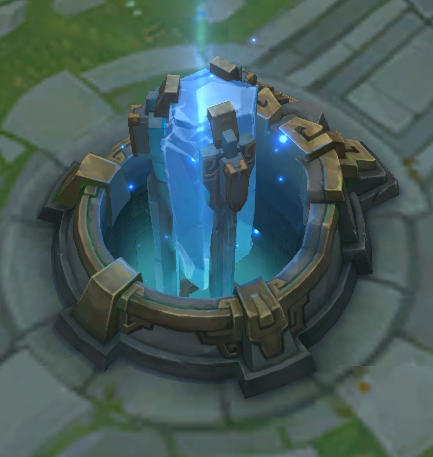
This is an inhibitor, yo.
As a team takes objectives and gains power and momentum, they can push into the late game, where the teams group up and fight to destroy the final defenses and destroy the enemy nexus.

Blue side's nexus, guarded by two towers to ward off attacks by the filthy purple team.

First to destroy the nexus wins, every time.  Doesn't matter how many kills you get; if you don't level up, buy items, take objectives, and destroy the nexus, you lose.

FREEEEEEEEDOOOOOOOOM

League of Legends is completely free to play.  Seriously.  You don't have to spend any money to enjoy every aspect of the game.  You can acquire every champion and play every game mode without spending a dime.  Playing a match earns you IP, which can be used to purchase champions as well as "runes" which give you slight stat boosts during a game.  

There are more than 120 champions in League of Legends, each with their own unique abilities and advantages.  There are close-range tanks that soak up damage and do annoying things to draw enemy fire.  There are ranged marksmen that dish out a lot of damage, but have to avoid TAKING damage because they are mighty squishy.  There are spellcasters and healers and assassins and a Koopa turtle with a spin move that looks like Sonic the Hedgehog.  Also robots and ponies and pirates and cowboys and a scarecrow.  And tiny little people called yordles with adorable chubbly cheeks.

SOOOO CUUUUUTE
Really, no matter your tastes, you're going to find champions that connect with you.

There are always 10 champions available without having to purchase them.  Those free champions rotate each week, so you can always try new champions.  Riot Games does a good job of giving players a good variety within the free champs--there's always at least one good champion for each of the five major roles, with a diversity of play styles and themes.  If you jump into the game, just try a few of the free champs and see what you like!

Once you've found characters that you like, you can purchase them in the store using the IP you've gathered from playing the game!

IP lets you buy everything in the game, with one exception.  Skins.

Skins.  Why did it have to be skins?

I know what you're thinking.  "Psh, why would I want to pay real money so that my fake digital character can wear different clothes?"

YOU CAN PUT THAT THOUGHT AWAY RIGHT NOW.

Why would you want your champion to look like this:

This is your Blitzcrank

When you could look like this:

This is your Blitzcrank on AWESOME

Would you really prefer this:

Say hello to Teemo
Over this:
Say hello to Teemo... IN SPACE

As much as I love this champion:

Oh, Anivia.  How I love you
I have to admit she looks much better like this:

WAAAAAAANT
I guess I can kinda see why some people would have trouble choosing between this:

Miss Fortune
And this:

Miss Fortune IN THE MAFIA WHY DO PEOPLE NEED CONVINCING ON THIS

Here's the thing about champion skins:  They don't JUST change how the character looks, although frankly that alone is pretty awesome.  They also add new or different phrases the champion will say--entirely new voice work for your character!  AND the animations are different, which doesn't just look cool, but can actually have a minor effect on the game.  If your opponent is used to your attack looking a particular way, then changing the animation can actually throw off their ability to dodge.  Which means that skins aren't just awesome, they can actually help you win!

But you can only acquire them by purchasing RP, which costs real dollars.  And let me tell you, plenty of people are shelling out, because Riot Games makes approximately ALL THE MONEY each quarter.  The League of Legends World Championship took place recently and had a prize pool of $2 million.

Still, you can thoroughly enjoy the game without ever spending any money at all.  And I really do think you'll enjoy it.

Download the game here.

Saturday, August 2, 2014

J-AWE Dropping Design

Andreas Propst, famed designer of such indie board game hits as Elemental Clash, Space Clash, and Biomechanical Dino Battles, is at it again.

Andi has a strong track record of taking solid game ideas and evolving them into polished products that are easy to learn, but with plenty of depth and strategy, and most of all, fun.  Now he has launched a Kickstarter campaign for his latest creation:  AWE - Antediluvian Wars: Extermination!

Check out the Kickstarter campaign here!

AWE on KS fb
AWWWWWWE YEEEEEAAAAAHH!!

AWE is exactly the kind of game I always wanted to design--an expandable, compact, two-player competitive card game in which each card can be used in multiple ways.  The versatility of the cards gives players a lot of interesting tactical decisions throughout the game.

As you can see in the example card below, each card can be used in three main ways.  Played right-side up, it is a creature that will stay on the board and fight for your cause until it is killed or you win the game.  Played upside-down, it is a one-shot event that will have an effect and then be discarded.  Played sideways, the card acts as a resource, allowing you to play more cards to bring your opponent to his or her knees.

Hyperborean Heavy Cavalry Sample
And check out that stellar art!

There's even a handy diagram to explain the concept:

How to play a card
Simple mechanic, tons of depth.  Each card immediately presents the player with three different decisions, and the choice the player makes will lead to further decisions.  When do I attack?  What do I target?  How do I allocate my resources?

In AWE, each player takes on the role of a God of one of four unique factions:  Mu, Lemuria, Atlantis, and Hyperborea.  Each God has two unique abilities that will give players an edge throughout the game.  Each faction has a different flavor and unique emphases.

Will you play as the Lemurians, dark-skinned masters of long-lost technologies such as flying warships and Thunderrods?

Perhaps you are more drawn to Hyperboreans, stout northerners who ride woolly rhinos and mammoths into battle to destroy their enemies with gunpowder and steam-powered weaponry?

Maybe you feel a connection with the sea-faring Atlanteans and their well-organized and well-trained infantry and cavalry--not to mention their ability to summon mighty sea serpents to do battle alongside them.

Or do the shamanistic Muans appeal to you with their powerful and versatile magic and their deep connection with nature?

Whatever you choose, you won't be wrong!

AWE Warrior Concepts
Unless of course you choose the Atlanteans.  Those guys are chumps!

Want to make sure this is your kind of game?  You can read the full game rules here.


The Kickstarter has already broken $1100 and is on its way to making the game a reality.  If this game sounds AWEsome to you, please consider backing it!  I already have, and I'm excited to get the game into my hands and the hands of my friends and family.  

If you're strapped for funds, please feel free to help spread the word by sharing the project on Facebook, Twitter, or on your blog.

Thanks for reading!